Why Indian Woodworking Is One of the Oldest Crafts Still Alive Today
Indian Woodworking History: The Legacy Behind Every Piece
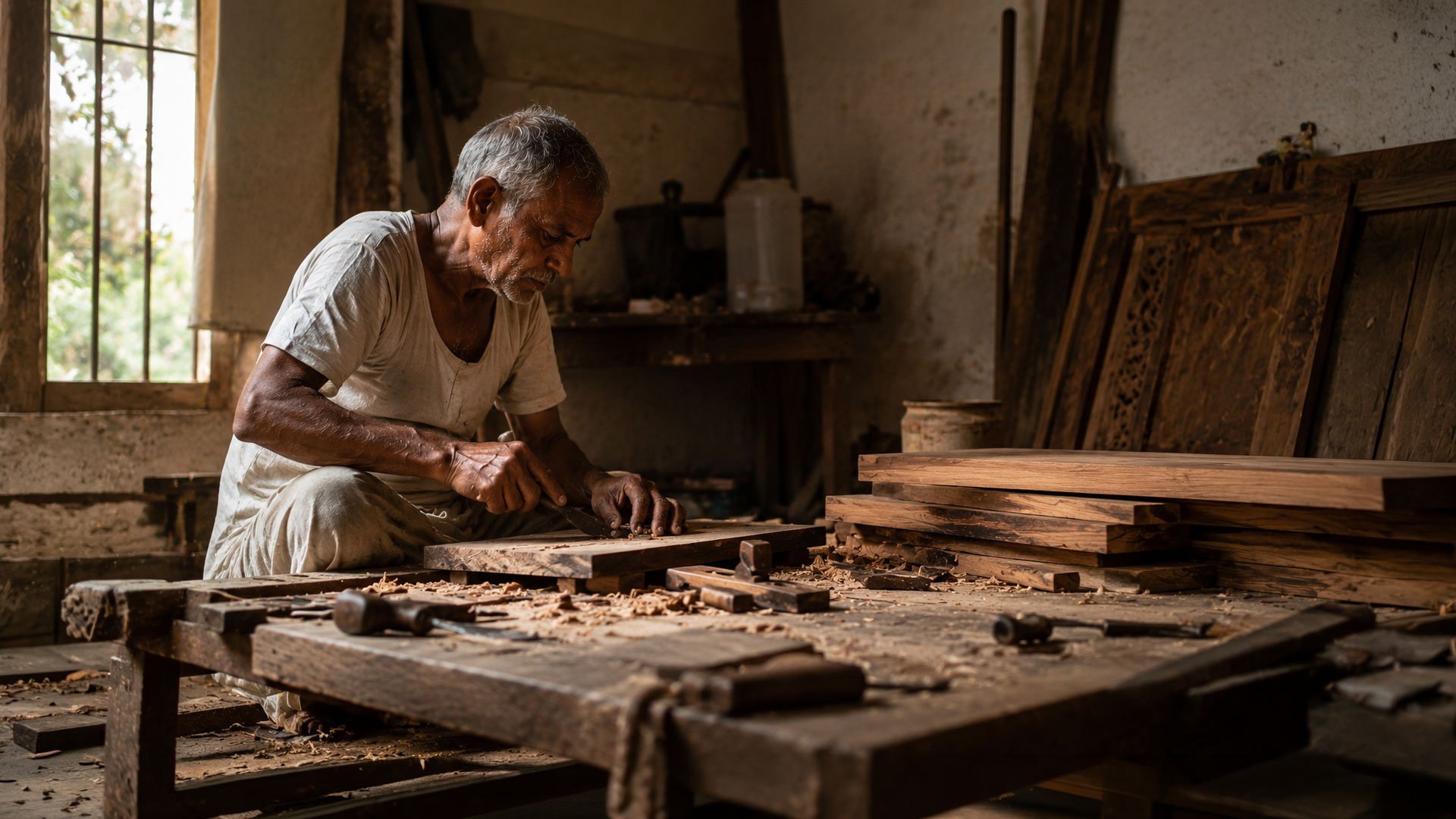
Ancient Techniques That Continue to Shape Modern Craft
The history of woodworking in India goes back further than most traditions the world currently calls classical.
Key markers of this deep lineage include:
- Excavations at Mohenjo-Daro and Harappa recovered wooden artefacts and tools dating to the third millennium BCE.
- The Arthashastra, compiled around 300 BCE, contains detailed references to wood classification, workshop organisation, and the formal roles of carpenters within the state economy.
- The craft was not incidental. It was documented, regulated, and taken seriously.
What makes this lineage remarkable is not its age. It is its continuity. The dovetail joint, the hand-carved finial, the inlay work in ebony and ivory found on Mughal court furniture: these are not historical footnotes.
Walk through a studio like AKFD in Jaipur, where chairs and tables carry the same structural clarity that once defined a master joiner's bench, and the line from then to now becomes visible.
These techniques are still being practised in workshops that are often family-run by artisans who learned from the generation before them.
Ancient Indian furniture techniques were not replaced by industrialisation. They were marginalised by it. That is a different thing entirely, and it matters for understanding where the craft stands today.
How Different Regions Shape Indian Woodworking
Regional woodworking styles in India are not variations on a single tradition. They are distinct craft languages, each shaped by local timber, local patronage, and local design history.
Saharanpur, Uttar Pradesh: Known for fine shisham carving. Intricate screens, furniture panels, and decorative objects have supplied both domestic and export markets for over two centuries.
Jaipur, Rajasthan: Home to studios like AKFD, where modern Indian classics take shape.
Clean, sculptural forms built on Rajput design discipline, proving that restraint and ornament can come from the same hand.
Jodhpur, Rajasthan: Works primarily in mango wood and old teak. Distressed finishes and bold forms carry the geometry of Rajput architecture directly into furniture.
Kerala: A quieter register but no less resolved. Jackfruit and teak come together with a structural logic shaped by the region's domestic architecture.
Gurgaon, Haryana: Studios like Chaukhat treat furniture as framing for daily life. Scale tuned to the room, finishes built to age well, and upholstery made to be lived in rather than displayed.
Tamil Nadu: The carved wooden panels of temples represent a distinct vocabulary entirely, in which motif and proportion follow a sacred grammar annotated and maintained over centuries.
Each of these traditions produces hand-carved furniture in India that cannot be replicated by someone who did not grow up inside the idiom. The regional specificity is not an aesthetic preference. It is the craft itself.
Materials That Defined Indian Woodcraft Over Time
The types of wood used in Indian craftsmanship follow both geography and purpose.
- Teak, a wood prominently used by The Studio Grain, has been the primary structural timber for furniture across most of India for centuries. Its density, resistance to moisture, and dimensional stability under seasonal humidity made it the default choice for pieces expected to last generations.
- Shisham, also called Indian rosewood, is denser still, with a grain that holds fine carving without splitting. Studios like AKFD work with shisham precisely because the material rewards the kind of meticulous joinery their workshop is built around.
- Mango wood, historically considered a secondary material, has found renewed appreciation for its figuring and its sustainability relative to old-growth hardwoods.
- Sandalwood, used for small objects and inlay, carries a cultural and spiritual weight well beyond its material properties.
- Ebony, once common in the furniture of South India and the Deccan sultanates, is now rare and protected.
Sustainable woodworking traditions in India have always drawn on what was locally available and regenerative. The shift toward mango and managed plantation timbers is consistent with how the craft has always responded to its environment.
How Indian Woodworking Survived Through Generations
The answer is not complicated, even if the reality behind it is.
It survived through families.
The sutradhar communities of Gujarat, the khatri woodworkers of Rajasthan, the vishwakarma artisan lineages found across multiple states: these were hereditary craft communities where skill was transmitted through apprenticeship within the household.
A child grew up watching, then assisting, then eventually inheriting both the tools and the understanding behind them.
Indian artisans in woodworking did not have academies. They had workshops. The knowledge was embodied, not written.
Which means it was as durable as the family lines that carried it, and as vulnerable as those lines the moment work dried up, sons moved to cities, or buyers stopped valuing what the hand made over what the machine could produce faster.
That quiet, generational transfer is what The Artisan's Signature You Didn't Notice points to: the unannounced authorship embedded in every piece, in the grain direction chosen, the joint angle held, the finish applied by a hand that has done it ten thousand times before.
The Cultural and Spiritual Influence on Woodcraft Design
Cultural Influence
Indian woodwork has never been purely functional. The forms were always carrying something else.
The carved lattice screens of Rajasthani havelis were architectural and social. They allowed women of the household to observe the street without being observed.
The interlocking geometry of jaali panels in Mughal-era furniture was both structural and symbolic, drawing on the same design grammar as stone screens in mosque architecture.
The khatambandh ceiling panels of Kashmir are a feat of joinery: hundreds of small pieces fitted without a single nail, and also a spatial statement about the home as a place of deliberate order.
The charpai is another example of this layered cultural meaning. What appears to be a simple woven bed is in fact a seat, a meeting place, and a record of how communities organise shared life.
The Politics of a Charpai traces exactly this: how a single object carries the full weight of domestic and social history.
Anantaya's Chotu Charpai reinterprets that history at a miniature tabletop scale, a playful and considered nod to an object that has never really been just furniture.
The way Indian furniture evolved through the twentieth century also reflects broader political and cultural shifts.
How India's 1930s Architecture Influenced Modern Furniture traces the line from civic design movements of that era into the domestic forms that followed, showing how woodcraft absorbed and responded to the world around it.
Spiritual Influence
Wood and sacred space have always been connected in India.
Temple chariots, processional structures, deity pedestals, and ritual objects are made from specific timbers considered auspicious, cut at particular times, and worked according to guidelines laid out in texts like the Manasara and the Mayamata.
The carpenter working on temple structures was not simply a craftsman. He was operating within a spiritual protocol.
This is not historical information without present relevance. Temple woodworkers in Kerala still follow these protocols. The craft and the sacred instruction have moved together, the whole way through.
Why Handmade Woodwork Still Holds Relevance Today
Because a machine cannot make a decision.
Handmade woodwork carries the record of choices: where to place the carving, how to respond to the grain, how tight to make the joint, and when the finish is right. These are not assembly instructions.
They are judgments, and they are made differently by every hand that makes them.
Heritage woodworking techniques in India are not being preserved out of nostalgia.
They are being specified by architects, designers, and homeowners because the result is different in ways that are visible in the finished piece and felt over the years of living with it.
That difference is also a form of resistance. Furniture as Resistance makes the case that choosing handmade work is not a lifestyle preference but a position: a refusal to accept that faster and cheaper is the only available logic.
The Sound of Craft takes this further, exploring the sensory and emotional register of objects made by hand, and why that register does not survive industrialisation.
A hand-carved piece from a Jodhpur workshop changes as the wood settles. It develops a surface character specific to how it has been used and where it has stood. A machine-made alternative does not do this. It simply ages.
Challenges Faced by Traditional Woodworking Communities
There are fewer master carvers working today than there were thirty years ago. The number is declining, and there is no easy mechanism to reverse that.
The economics are genuinely hard. Handmade woodwork is labour-intensive, and the price the market has historically offered has not kept pace with the cost of skilled time.
Young people in craft families weigh the years of apprenticeship against the income it produces, and often choose differently.
When a master retires without passing the full body of knowledge to the next generation, that knowledge is gone. Not archived. Gone.
The challenge is not only financial. Traditional woodworking communities in India have rarely had access to specification-grade catalogues, professional photography, or direct connections to buyers who understand and will pay for what the work actually represents. The craft existed. The infrastructure around it did not.
How Casa Carigar Preserves and Reinterprets Indian Craft
Every piece in the Casa Carigar collection comes from workshops audited for material provenance, technique, and finish quality. Every piece carries the maker's credit: the workshop, the region, the technique, the timber.
The platform was built on one premise. The makers were already here. What was missing was the infrastructure to connect them to buyers who would understand what they were making and value it accordingly.
That philosophy extends to the materials themselves. Casa Carigar sources solid teak from Mysuru and cane from Coimbatore, a commitment to regional authenticity that mirrors the way Indian woodcraft has always worked: rooted in place, shaped by what the land and the community around it could sustain.
The studios Casa Carigar works with reflect that same conviction. AKFD Studio is curated for its deep respect for timber grains and meticulous workshop joinery, constructing structural proportions in native woods like Acacia, Mango, and Shisham that ground spaces with a quiet, timeless gravity.
The Studio Grain edits classical Indian woodcraft into sleek, hyper-minimal silhouettes, working with reclaimed palace hardwoods salvaged from historic Jodhpur palaces and employing centuries-old Himalayan tool-free joinery techniques.
Arjunvir Gujral Design Studio demonstrates how custom Indian carpentry can achieve fluid mechanical precision without surrendering historical gravity, with pieces like the Tambour Bar Unit showing exactly where craft and engineering meet.
b.form studio transforms solid teak and mathematical wood intarsia into objects that ask you to slow down, intricate coffee tables that function less as furniture and more as extended acts of attention.
A carved shisham console from Saharanpur, specified, photographed, and placed in a well-designed room in Bandra, tells a different story than the same piece sitting in a warehouse without context. The craft does not change. The visibility does.
Discover the collection at casacarigar.com.
FAQ
How old is woodworking in India?
Woodworking in India dates back at least 5,000 years, with evidence found in ancient Harappan settlements. Its long history reflects a deeply rooted tradition of craftsmanship, material knowledge, and skilled artistry.
What are traditional Indian woodworking techniques?
Traditional Indian woodworking relies on techniques such as mortise-and-tenon joinery, intricate carving, jaali work, and decorative inlay. These methods showcase remarkable precision and have been passed down through generations of artisans.
Which wood is commonly used in Indian furniture making?
Teak, shisham, and mango wood are among the most commonly used materials in Indian furniture making. Each is valued for its durability, natural beauty, and ability to age gracefully over time.
Why is Indian woodworking important?
Indian woodworking preserves centuries of cultural heritage, regional design traditions, and specialised craftsmanship. Supporting the craft helps keep these valuable skills alive for future generations.
Casa Carigar
From the Casa Carigar workshop