How India's 1930s Architecture Influenced Modern Furniture
A deep dive into how Indian modern architecture continues to inspire furniture design.
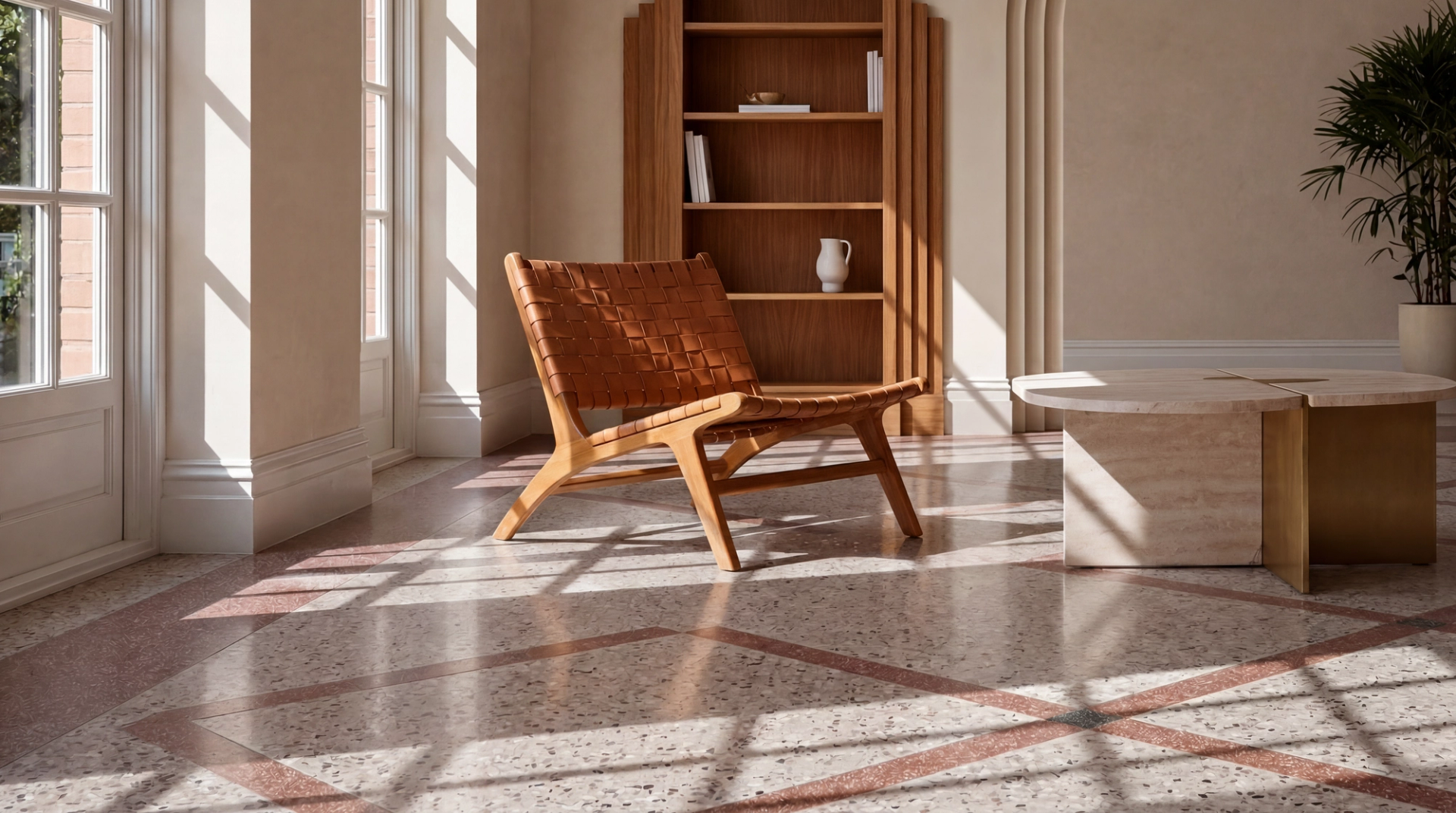
The history of Indian modern furniture is, at its heart, a story told through stone and concrete before it was ever told in wood.
Long before the first sleek teak credenza appeared in a Bombay living room, the city’s skyline had already undergone a physical recalibration. The 1930s did not just change how buildings looked, but how they functioned.
As Art Deco apartments and sweeping cinemas rose along the coast, they introduced a domestic scale that demanded a new kind of inhabitant and a significantly leaner kind of chair.
What we now recognise as Indian modernism did not arrive via a singular manifesto. Instead, it slipped through the ports of Bombay and Calcutta, hidden in the geometry of architectural blueprints and the pages of imported catalogues.
This era marked a departure from the heavy, status-driven ornamentation of the Victorian past, replacing it with a spatial logic where furniture became a natural extension of the room itself.
By prioritising clean lines, tactile materials like cane and teak, and a newfound sense of urban efficiency, 1930s architecture essentially taught Indian furniture how to modernise.
Key Takeaways
- The history of Indian modern furniture emerged from architectural change rather than decorative trends, with 1930s Art Deco buildings redefining how interiors were planned and used
- Architecture introduced principles of proportion, efficiency, and structural clarity that directly shaped furniture design in urban Indian homes
- Materials such as teak, cane, steel, and terrazzo moved seamlessly from buildings into furniture, reinforcing durability and functional aesthetics
- Cities like Bombay played a central role by normalising modern interiors through apartments, cinemas, and public institutions
- The enduring relevance of 1930s design lies in its balance of functionality, longevity, and cultural confidence, principles that continue to influence contemporary Indian furniture today
1930s Indian Architecture and the Quiet Arrival of Modernism
Art Deco as India’s First Urban Modern Language
By the early twentieth century, India’s architectural landscape was already dense with symbolism. Victorian Gothic and Indo-Saracenic styles had come to represent imperial authority, historical continuity, and monumental power.
Against this backdrop, Art Deco entered not as a rebellion but as an alternate, lighter, cleaner, and notably free from overt colonial messaging.
Unlike revivalist styles that sought legitimacy through historical reference, Deco offered something else: a visual language that appeared contemporary without demanding allegiance to the past.
What distinguished Art Deco in India was not novelty alone, but compatibility. Its emphasis on geometry, proportion, and functional planning resonated with a society negotiating modern life under colonial constraint.
Rather than rejecting tradition outright, Deco allowed Indian architects and patrons to step beyond Victorian heaviness without embracing abstraction or austerity.
In this sense, pre-independence Indian design found in Deco a means of expressing confidence, progress, and participation in a global modern world, without forfeiting cultural continuity.¹
Bombay and the Birth of Modern Living
No city absorbed this shift more decisively than Bombay. As a port city and commercial hub, Bombay had long been exposed to global flows of people, ideas, and commodities. By the 1930s, it had become the primary stage for India’s encounter with modern urban life.
Deco cinemas, apartment buildings, and offices emerged along its expanding coastline and arterial roads, quietly redefining how space was organised and experienced.
These were not symbolic monuments but functional structures designed for contemporary routines: apartment living, leisure, hygiene, and privacy. Architecture began to respond to how people actually lived rather than how power wished to be seen.
This shift is crucial because it placed interiors, and by extension furniture, at the centre of modern design thinking. Bombay Art Deco interiors did not simply decorate space; they disciplined it.²
Architecture as the Blueprint for Furniture Design
Furniture as Architectural Extension
The architectural influence on furniture in this period was not metaphorical; it was direct. Art Deco buildings in India prioritised clarity of structure, legibility of form, and efficient use of space.
Furniture followed suit. Chairs, wardrobes, tables, and seating systems were no longer conceived as independent artefacts laden with ornament, but as components within a larger spatial logic.
This marked a decisive shift in the history of Indian modern furniture. Furniture began to mirror architectural values: clean lines replaced excessive carving, structural frames became visible rather than concealed, and proportion mattered more than embellishment.
In apartments designed for compact urban living, furniture had to negotiate circulation, light, and climate. The result was a new discipline of design: functional, restrained, and spatially aware.³
Built-in Thinking and the End of Excess
One of the most telling outcomes of this architectural shift was the rise of built-in furniture.
Wardrobes embedded into walls, seating aligned with room geometry, and storage integrated into architectural planning reflected a growing awareness of space as finite and valuable.
This was not minimalism in the European sense, but pragmatism shaped by urban density and climate.
Functionalism gradually displaced ornamentation. Furniture was expected to last, to endure daily use, and to adapt to Indian conditions.
Where European Deco furniture often pursued lacquered surfaces and exotic veneers, Indian versions retained tactile weight.
Polished teak, cane panels, and robust joinery offered durability without sacrificing modernity. Furniture inspired by architecture thus became an exercise in balance rather than spectacle.⁴
Materials and Forms: From Buildings to Objects
A Shared Material Vocabulary
The materials that defined 1930s Indian architecture inevitably shaped its furniture. Reinforced concrete, steel, terrazzo, granite, teak, and cane formed a shared vocabulary across scales.
These materials were not chosen for novelty but for resistance to climate, longevity, and availability.
Teak, in particular, became central to colonial modern furniture in India. Its density and resistance to humidity made it ideal for structural furniture forms, while cane introduced lightness and ventilation.
Steel and chrome, used sparingly, signalled modernity without overwhelming domestic comfort. Terrazzo and stone surfaces migrated from floors to tabletops, reinforcing continuity between architecture and interior objects.⁵
Curves, Symmetry, and Streamlining
Formal qualities also travelled across scales. Streamlined curves, horizontal emphasis, and symmetrical compositions, the hallmarks of Deco architecture, reappeared in furniture silhouettes.
Rounded balconies found echoes in curved armrests; banded façades translated into layered cabinetry; and modular planning encouraged repeatable furniture forms.
Crucially, structure and aesthetics were not separate concerns. Furniture revealed how it stood and how it was made.
This honesty of construction aligned with a broader Indian modernist movement that valued intelligibility over excess. Form followed use, but without sacrificing elegance.
Cities, Institutions, and the Spread of Modern Taste
Beyond Bombay: Regional Modernisms
While Bombay served as the epicentre, Deco modernism spread across Indian cities, adapting to local contexts. In Chennai, Bangalore, Ahmedabad, and Calcutta, planned suburbs and middle-class housing embraced simplified modern forms.
These environments demanded furniture that was economical, durable, and suited to daily life rather than display.
Here, modern Indian furniture design became quieter and more pragmatic. The emphasis shifted toward utility and adaptability, reinforcing the idea that modernism in India was not singular but regional, and was shaped by climate, economy, and social aspiration.⁶
Cinemas and Institutions as Design Laboratories
Public buildings played a critical role in disseminating modern taste. Art Deco cinemas, in particular, functioned as immersive environments where architecture, interiors, lighting, and furniture formed a coherent visual experience.
Seating systems, ticket counters, lounges, and bars were designed for repetition, durability, and crowd use.
For many Indians, these spaces provided their first encounter with modern design. Furniture here was not exclusive or elite; it was encountered collectively.
In this sense, cinema architecture acted as a democratic conduit, normalising modern forms and embedding them in popular consciousness.
Princely Patronage and the Total Design Ideal
Modernity as Identity
While middle-class housing anchored everyday modernism, princely patronage pushed Deco toward its most radical expressions.
For Indian royals navigating a changing political order, modern design offered a means of projecting relevance, sophistication, and global belonging.
Architecture, interiors, and furniture became tools of identity rather than mere status symbols.
Manik Bagh: Architecture and Furniture as One System
Nowhere is this integration more visible than at Manik Bagh in Indore. Designed in 1930 by Eckart Muthesius for Maharaja Yeshwant Rao Holkar II, the palace represents a rare moment when architecture and furniture were conceived as a single system.
Muthesius designed not only the building but also the furniture, lighting, and interiors, many of which were produced in Europe and shipped to India.
The furniture was strikingly restrained: wood and metal forms prioritised function, proportion, and clarity.
Alongside these bespoke pieces, the Maharaja acquired works by leading modernist designers, situating Indian interiors within a global avant-garde dialogue.
Manik Bagh thus stands as a pivotal chapter in pre-independence Indian design, one where furniture explicitly followed architectural ideology rather than decorative tradition.⁷
The Lasting Impact on Contemporary Indian Furniture
Why Deco Never Disappeared
Unlike in Europe, where Deco was eventually eclipsed by stricter modernism, the style endured in India.
Part of this longevity lies in use. Furniture and interiors designed in the 1930s continued to function well beyond independence, often repaired, reupholstered, and repurposed rather than discarded.
This continuity gave Deco a lived presence rather than a museum existence. It became part of domestic inheritance, shaping taste across generations.
In doing so, it quietly influenced the trajectory of modern Indian furniture design long after the style itself faded from architectural fashion.⁸
Revival, Reinterpretation, and Heritage Modern Interiors
Today, contemporary designers frequently return to Deco principles—not as nostalgia, but as a method.
Clean lines, strong proportions, tactile materials, and architectural discipline resonate in bespoke furniture and heritage modern interiors alike.
The appeal lies not in ornament but in intelligence: furniture that understands space, use, and longevity.
In an era increasingly concerned with sustainability, the Deco legacy feels unexpectedly current. Its emphasis on durability, adaptability, and structural honesty offers lessons for contemporary practice, reminding designers that modernity need not be disposable.
Conclusion: Architecture as the Origin of Modern Indian Furniture
The history of Indian modern furniture cannot be written without architecture at its centre. In the 1930s, as India negotiated its place between empire and independence, buildings quietly redefined how space was organised and lived in.
Furniture followed, not as a secondary concern, but as an extension of architectural thought.
Art Deco’s lasting influence lies precisely here: in its ability to translate modern ideals into everyday objects without severing ties to material culture or climate.
By teaching furniture how to think architecturally, 1930s Indian architecture established a design legacy that continues to shape interiors today.
What emerged was not merely a style, but a way of living, one that remains embedded in the fabric of modern Indian homes.
Endnotes
Sonal Shah, Introduction of Art Deco in Pre-Independent India.
Ibid.; see also discussions on Bombay’s role as a modern gateway.
Shah, Introduction of Art Deco in Pre-Independent India.
From Paris to Bombay: How Art Deco Quietly Arrived in India, The Collectors.
Ibid.
Shah, Introduction of Art Deco in Pre-Independent India.
Amin Jaffer, “Indo-Deco,” in Art Deco: 1910–1939.
From Paris to Bombay, The Collectors; Vogue India, How Art Deco Has Carried on an Enduring Love Affair with India.
Frequently Asked Questions
1. What architectural styles were popular in India in the 1930s?
In the 1930s, Indian architecture reflected a shift away from heavy colonial styles such as Victorian Gothic and Indo-Saracenic. Art Deco emerged as a modern alternative, particularly in urban centres. Its emphasis on geometry, proportion, and functional planning made it well-suited to changing lifestyles in pre-independence Indian cities, especially Bombay.
2. How did Art Deco influence Indian furniture design?
Art Deco influenced Indian furniture through architecture rather than decoration. As buildings adopted cleaner lines and efficient layouts, interiors required furniture that was functional, structurally clear, and space-conscious. Materials like teak, cane, and steel were used to create furniture that balanced durability with modern form, shaping an important phase in the history of Indian modern furniture.
3. Which Indian cities shaped early modern furniture?
Bombay played the central role, with its Art Deco apartments, cinemas, and offices setting new standards for interior planning and furniture use. Other cities such as Chennai, Ahmedabad, Bangalore, and Calcutta developed regional versions of modern design shaped by climate, planned neighbourhoods, and middle-class housing.
4. Why is 1930s design still relevant today?
Design from the 1930s remains relevant because it prioritised proportion, functionality, and longevity. Furniture from this period was built to endure and adapt, making it both sustainable and culturally resonant. These principles continue to inform modern Indian furniture design and heritage-led interiors today.
Team Casa Carigar
From the Casa Carigar workshop