Why Are Handmade Rugs So Expensive? What Goes Into Every Knot
Why Are Handmade Rugs Expensive? What Makes Them Worth It
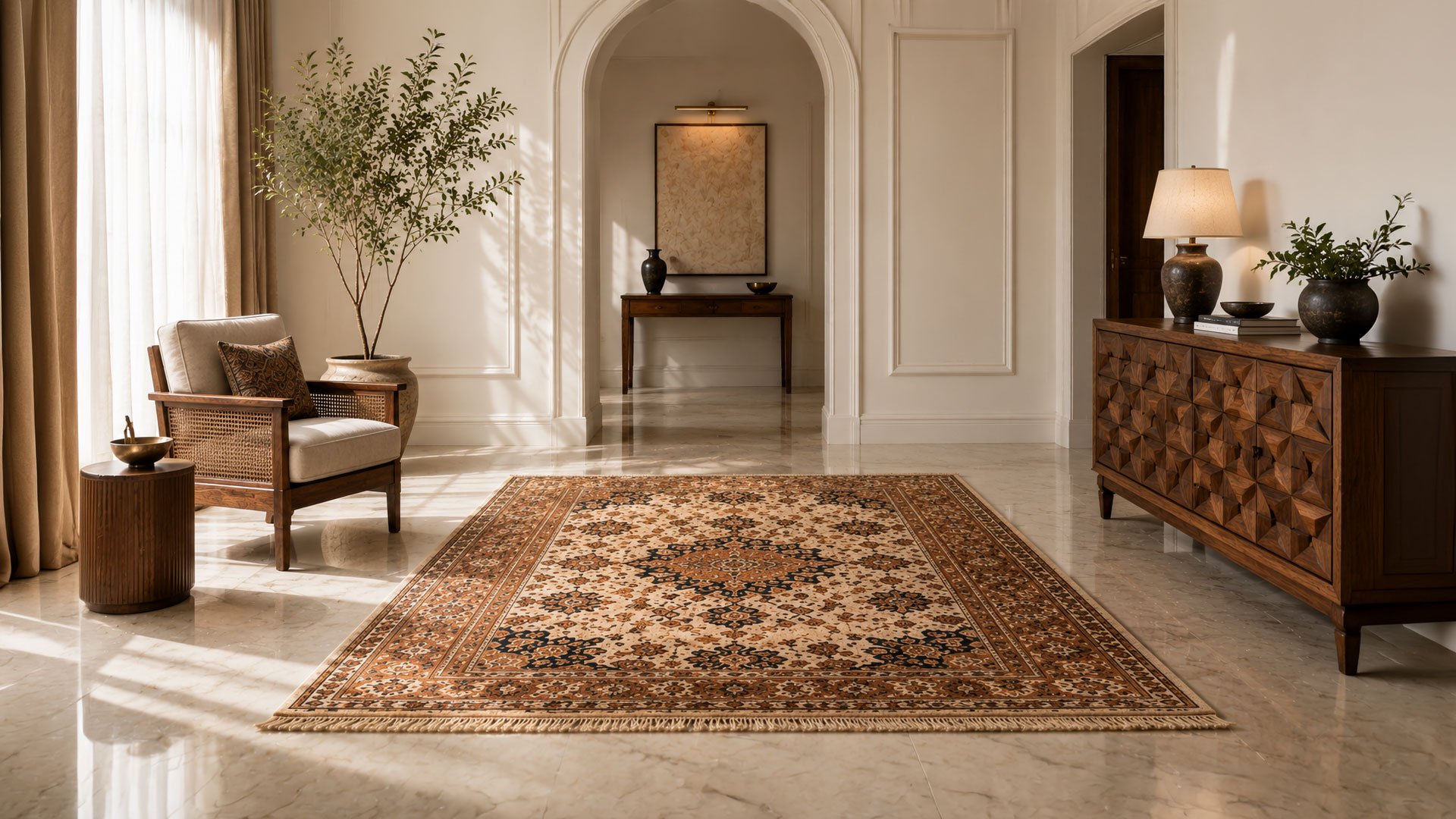
Someone asked me once why a handmade rug costs what it costs.
Not rudely. Genuinely. They had seen a number and wanted to understand what was behind it.
The honest answer is that the number is not the interesting part. What is interesting is everything that produced it.
Table of Contents
- Why Are Handmade Rugs Expensive Compared to Machine-Made Options
- Why Knotting a Rug Takes So Long
- Materials Matter: Wool, Silk, and Natural Dyes Explained
- How Long Does It Take to Create a Single Handcrafted Rug
- Craftsmanship and Heritage
- Durability and Longevity
- Design Complexity and Customisation in Handmade Rugs
- Ethical Production and the True Cost of Artisan Labour
- Are Handmade Rugs Worth the Investment for Your Home?
Why Are Handmade Rugs Expensive Compared to Machine-Made Options
A machine-made rug can be produced in minutes. Rolls of synthetic fibre, a programmed loom, a finished product that looks like a rug and functions like one.
A hand-knotted rug from a workshop in Jaipur or Bhadohi is something else entirely. Every knot is tied individually, by hand, onto a vertical warp.
A skilled weaver working at pace can tie roughly ten thousand knots in a day. A medium-sized rug at a standard knot density contains several million.
The maths from there is not complicated. But the maths is also not really the point.
The Casa Carigar manifesto holds the position plainly: mass production is an absence here, not a future.
The platform's dedication to preserving the exact way pieces were made decades ago, using authentic materials rather than automated assembly lines, is the context within which every rug in the collection exists.
Why Knotting a Rug Takes So Long
The artisan rug-making process is not slow because it is inefficient. It is slow because it cannot be otherwise.
Each knot is a decision. The weaver reads the cartoon, the gridded design map that translates the pattern into individual colour placements, and ties accordingly.
At high knot densities, the distinction between one colour and its neighbour is a matter of a single thread.
Get it wrong, and the correction requires unpicking backwards. No algorithm catches it. No quality control pass retrieves it after the fact.
The weaver catches it, or nobody does.
Cocoon Fine Rugs makes this labour visible in the finished piece. Their artisans tie millions of individual yarn nodes by hand onto a vertical loom foundation, a process that yields structural depth, knot density, and a plush tactile richness that no machine replicates.
The Ambiente draws on multi-generational artisans for their hand-knotted heritage and collector lines, a process that is precisely what gives their rugs heavy pile recovery and premium structural durability.
That kind of attention does not compress. It costs time because time is what it requires.
Materials Matter: Wool, Silk, and Natural Dyes Explained
The quality of handcrafted rugs begins well before a single knot is tied.
Hand-spun wool from Himalayan sheep has a lanolin content that repels dust and moisture.
It takes dye differently from machine-processed wool and ages into a softness that synthetic pile never reaches.
Silk, used in the finest pieces, carries a lustre that shifts with the angle of light and holds detail at knot densities that wool physically cannot.
Cocoon Fine Rugs holds a strict position on materials. Their pieces use 100% Pure Handspun Afghan Wool, pure natural cotton, and 100% Pure Silk yarns exclusively, rejecting synthetic fibres and plastic backings entirely.
The Ambiente works with a complementary palette of elite natural fibres: premium New Zealand Wool, chosen for its organic bounce and natural stain resistance, and Bamboo Silk, used to create a luminous, liquid-like sheen.
Natural dye rugs carry their own argument. Pomegranate rind, indigo, madder root, walnut husk. These are not romantic additions to a product description.
Natural dyes bind differently to protein fibres than synthetic dyes do. They fade slowly and evenly over decades, producing the quality known as abrash: the gentle tonal variation that tells you a rug has aged honestly.
A synthetic dye fades faster and less gracefully. The difference is visible to anyone who has stood in front of both.
How Long Does It Take to Create a Single Handcrafted Rug
A modest hand-knotted carpet, roughly two metres by three, takes a single skilled weaver between six and twelve months to complete.
Larger pieces, or those with higher knot densities and more complex pattern work, take longer.
Some of the finest pieces coming out of Kashmiri workshops represent two to three years of continuous work.
That number is not a justification for a price. It is simply what the object is.
Craftsmanship and Heritage
The hand-knotted carpet value conversation cannot be separated from lineage.
Weaving traditions in Bhadohi, Mirzapur, and Kashmir have been passing technique between generations for centuries.
The way a weaver reads a cartoon, the way tension is maintained across the warp, the way a pile is cut to height by feel rather than measurement: these are not skills learned from a manual.
They are accumulated across years of practice, inside workshops where the knowledge lives in the hands of the people working there.
The Casa Carigar editorial The Artisan's Signature You Didn't Notice sits with this directly.
The quiet marks, the unsung authorship, the material choices made by hand in real time: these are what sterile factories completely lack, and what every hand-knotted rug carries whether or not anyone thinks to name it.
When one of those weavers retires without passing on their method, something specific is lost. Not a process. A particular understanding of that process that no other weaver has in quite the same way.
Durability and Longevity
Do handmade rugs last longer? The short answer is yes, significantly.
A well-maintained hand-knotted rug made from quality wool or silk does not degrade the way a machine-made pile does.
The knots are structural. They do not pull loose under foot traffic; they compress and recover.
Natural fibres respond to cleaning in ways that extend the life of the piece rather than diminish it.
Antique rugs from Persia and Central Asia that are two hundred years old are still in use. That is not nostalgia. It is material performance.
Cocoon Fine Rugs builds explicitly toward this outcome. Their focus on functional longevity, through dense hand-knotting and premium natural materials, produces rugs with outstanding structural recovery.
Pieces that do not merely survive decades but grow in beauty and character across them.
Their signature Complete Motif Oxidation process, a controlled distressing technique that breaks down specific wool segments, gives classic Persian layouts a weathered, textured vintage quality that no automated machine could authentically produce.
The handmade rug cost factors are partly the time, partly the material. Partly also the fact that you are buying something that will outlast most of the furniture around it.
Design Complexity and Customisation in Handmade Rugs
A machine-made rug repeats its pattern exactly and indefinitely. That is what machines do well.
A hand-knotted rug at high density can hold a level of design complexity that no machine replicates.
Curvilinear floral patterns, pictorial medallions, the intricate border systems of classical Persian and Mughal design: these are only achievable through individual hand placement of each knot.
The difference between handmade and machine-made rugs is visible in the curves. A machine produces a stepped approximation. A hand-knotted rug produces the actual curve.
Customisation is also a different proposition. A master weaver working to a bespoke brief can adapt a traditional pattern to a specific room's proportions, modify a colour palette to work against a particular stone floor, or incorporate a design element that exists nowhere in an existing catalogue.
Ethical Production and the True Cost of Artisan Labour
The investment value of handmade rugs is inseparable from who made them and under what conditions.
The luxury rug price conversation often avoids a direct question: what does a fair wage for this work actually look like?
The answer, worked out honestly, explains a great deal about why pieces made with genuine craft integrity cost what they cost.
Shortcuts in that calculation show up eventually, in the materials, in the finishing, in how the piece ages.
The Ambiente addresses this directly through their Social Weaver Empowerment Matrix, a verified commitment to supporting rural North Indian craft networks that actively champion fair compensation for women weavers.
Buying one of their pieces is not a passive transaction. It is a decision about who gets paid for what they know.
A rug that takes eight months to make and reflects fair payment for that labour is priced accordingly. That is not a premium. That is an accurate number.
Are Handmade Rugs Worth the Investment for Your Home?
Here is what I have come to think.
The question of whether a handmade rug is worth it depends entirely on what you are comparing it to.
If the comparison is a machine-made rug that will need replacing in a decade, the handmade piece at three or four times the price and a lifespan of fifty years is not expensive at all.
If the comparison is any other object you could bring into a room, consider what else carries centuries of accumulated technique, improves with age, holds its resale value, and anchors a space with the kind of warmth that no tile or polished concrete floor achieves on its own.
The Ambiente puts it simply: a rug is not a passive surface cover. It is an active canvas for fine expression, carrying the same emotional weight as a work hung on a wall. The difference is that you walk on this one every day.
A rug is the foundation of a room. Getting it right matters more than most decisions made above it.
The knots are the proof of that. Every single one of them.
Explore the full collection at Casa Carigar.
FAQs
Why Are Handmade Rugs So Costly?
Handmade rugs reflect hundreds of hours of skilled craftsmanship, premium natural materials, and time-intensive weaving techniques. Their value lies in the artistry, durability, and heritage woven into every piece.
How Can You Tell If a Rug Is Handmade or Machine-Made?
A handmade rug reveals individual knots on the back, with the design clearly visible from both sides. Subtle variations in texture and pattern are also signs of craftsmanship, adding character rather than imperfection.
Do Handmade Rugs Last Longer?
Yes. A well-crafted, handmade rug can last for generations when properly cared for. Its durable construction and natural fibres allow it to age beautifully while retaining its strength and character.
What Materials Are Used in Handmade Rugs?
Traditional handmade rugs are typically crafted from:
- Wool
- Silk
- Cotton
These natural materials are prized for their durability, texture, and ability to develop greater character over time.
Casa Carigar
From the Casa Carigar workshop