MDF vs Plywood: How to Tell What You're Buying Before You Pay for It
MDF vs Plywood: Which Is Better for Furniture?
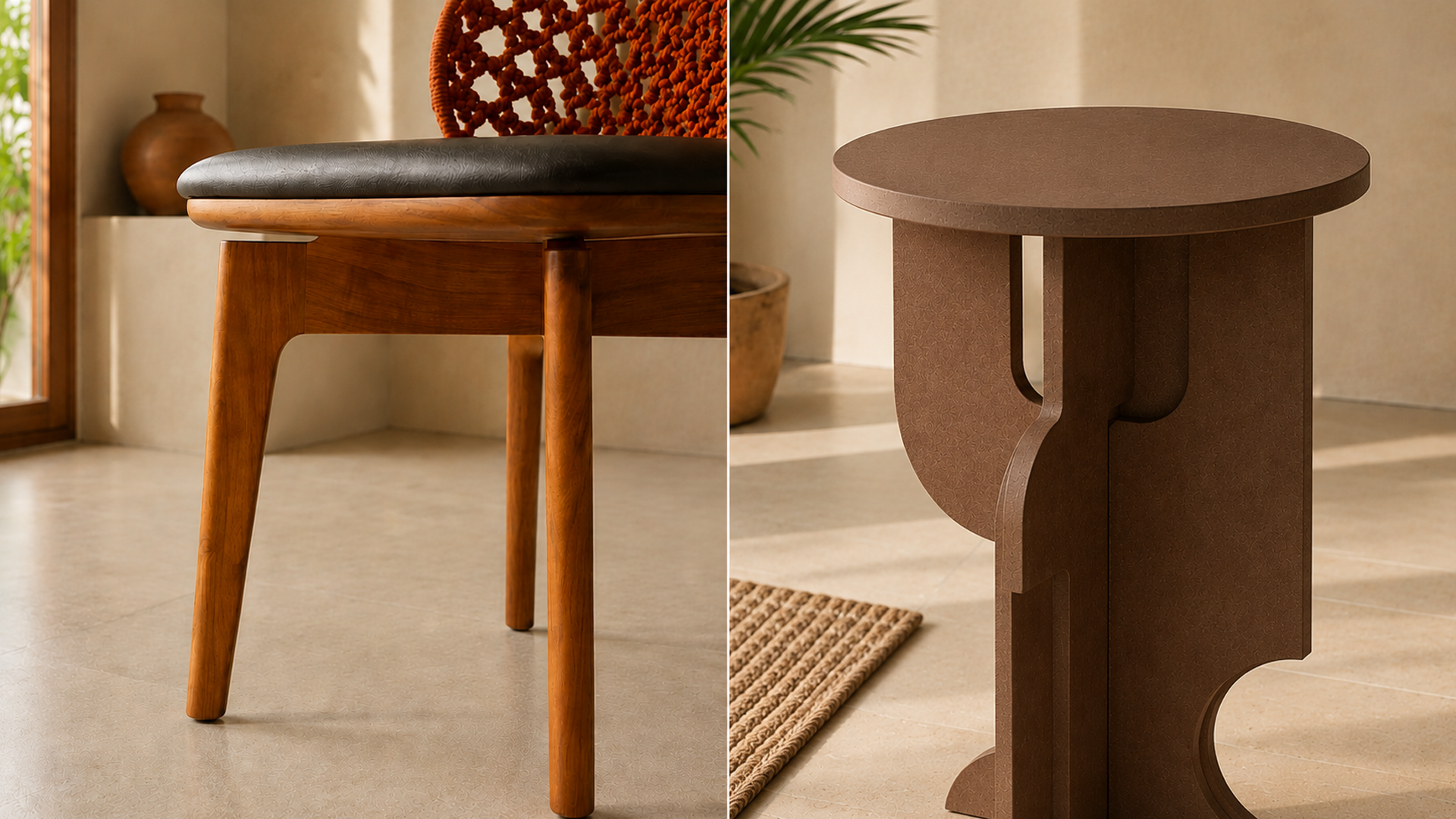
You are about to spend real money on a piece of furniture. Nobody tells you what is actually inside it.
The mdf vs plywood question sounds technical. It is not. It is the difference between a table that lasts fifteen years and one that swells the first monsoon it meets.
Table of Contents
- MDF vs Plywood: What Are These Materials Actually Made Of?
- How to Identify MDF and Plywood Before You Buy
- MDF vs Plywood: Strength, Weight and Durability Compared
- Which Material Handles Moisture and Humidity Better?
- How MDF and Plywood Compare for Furniture Construction
- What to Check at the Edges, Surface and Joints
- MDF vs Plywood: Which One Offers Better Long-Term Value?
- Where MDF Makes Sense and Where Plywood Is the Better Choice
- Questions to Ask Before Buying Engineered Wood Furniture
- How Casa Carigar Approaches Materials and Furniture Construction
MDF vs Plywood: What Are These Materials Actually Made Of?
MDF, or medium-density fibreboard, is wood reduced to its smallest form. Fibres, resin, heat, pressure. Pressed flat until it forgets it was ever a tree.
Plywood works differently. Thin sheets of real wood, layered with the grain running in alternating directions, glued and pressed together. Each layer works against the next. That is where its strength comes from.
Neither is fake wood. Neither is automatically bad wood. What matters is which one is doing the job it was built for.
How to Identify MDF and Plywood Before You Buy
Most furniture buyers never check. This is where the trouble starts. A few honest clues:
- Look at a cut edge. Plywood shows visible layers, like the rings of a tree turned sideways. MDF shows a flat, uniform, almost powdery surface.
- Knock on the surface. Plywood sounds hollow and light. MDF sounds dense and dull.
- Check the weight. MDF is heavier for its size. Density is not always strength.
- Ask what sits under the veneer. A polished top tells you nothing about the board beneath it.
This is also where honesty separates a maker from a manufacturer. On Casa Carigar, the material coordinates are never hidden behind a finish. The wood, the city, the maker are named on the product page, not buried in a spec sheet nobody reads. The Artisan's Signature You Didn't Notice goes deeper into this, into what the hand leaves behind that a machine cannot fake.
MDF vs Plywood: Strength, Weight and Durability Compared
- Plywood holds screws and hinges far better. It does not crumble at the joint.
- MDF dents more easily under sharp impact but resists warping across flat, wide surfaces better than solid boards.
- Plywood carries weight across a span with less sagging over time.
- MDF, when made dense enough, takes intricate carving and sharp edges that plywood cannot hold cleanly.
Strength is not a single number. It depends on what the piece is asked to do.
Which Material Handles Moisture and Humidity Better?
Standard MDF and humidity are not friends. It swells, softens, and does not fully recover. Plywood resists moisture better because of its cross-grain layering, though it is not immune either.
There is an exception. High-density fibreboard, or HDF, is a far denser, moisture-resistant cousin of ordinary MDF. It behaves nothing like the cheap board most people picture.
How MDF and Plywood Compare for Furniture Construction
This is where craft studios reveal the difference between a shortcut and a decision.
Some designers reject engineered board outright. Others use it with intent. Consider how a piece is built, not just what it is called.
- Premium HDF, when selected deliberately, allows master carvers to cut sharp, intersecting facets that catch changing light, the kind of geometry you see in the Trinity Sculpture and Inverto Wall Art from La Dimora Selections, a studio that chooses dense, dimensionally stable board specifically for structural decor panels and tables.
- The same studio's Apostrophe Coffee Table nests a thick float glass top over a heavy, matte engineered wood base, proving the material can carry architectural weight without looking heavy.
- Where safety matters most, Waddle & Roo builds children's furniture around heavy gauge, non-toxic HDF panels and multi-layered birch ply, tested against drops and years of daily use.
- On the plywood and veneer side, BEC Furniture pairs high-density solid wood bases with matched ash veneer to avoid the warping that wide solid slabs are prone to, the reason pieces like the Nest Work Table and Flow Work Table hold their clean, continuous lines without splitting.
What to Check at the Edges, Surface and Joints
- Run a finger along the edge. A veneer edge should feel seamless, not like a sticker.
- Check joints for glue residue or visible gaps. Good joinery hides nothing and needs nothing to hide.
- Look for grain continuity across a veneered surface. Mismatched grain is a shortcut, not a style.
- Press gently near a corner. Give and flex tell you more than any brochure will.
MDF vs Plywood: Which One Offers Better Long-Term Value?
Cheap MDF costs less today and more later, once it swells, sags, or needs replacing. Plywood and premium HDF cost more upfront and ask less of you afterward. Long-term value was never about the lowest number on the price tag. It was always about what you are not paying for twice.
Where MDF Makes Sense and Where Plywood Is the Better Choice
MDF, particularly dense HDF, earns its place in carved panels, painted furniture, and pieces where a flawless, uniform surface matters more than raw load-bearing strength. Plywood earns its place in structural frames, shelving, and anything that will carry weight for decades.
And then some pieces reject the debate entirely. Home of Chirmi builds skeletal frameworks exclusively from solid ash, teak, and wenge, no engineered substrate at all, because some furniture is meant to outlive the person who bought it. The Studio Grain sources FSC-certified solid Himalayan teak for its tight, stable grain, and their Kari Wall Shelf is built from reclaimed antique teak salvaged from historic Jodhpur palaces, timber with a history no synthetic board could ever claim.
Questions to Ask Before Buying Engineered Wood Furniture
- What exact board is used, and where was it sourced?
- Is the veneer real wood or a printed laminate?
- What is the moisture rating, and does the piece suit your climate?
- Who made this, and what do they specialise in?
How Casa Carigar Approaches Materials and Furniture Construction
A board is not a detail to gloss over. It is the decision that determines whether a piece ages with you or against you. Every maker on the platform is chosen because they treat that decision the way it deserves to be treated, named plainly, never disguised behind a finish. This is not a policy written for a catalogue. It is simply what happens when the people building your furniture actually respect the wood they are working with.
Some questions are worth asking before you pay, not after you notice the swelling at the edge.
FAQs
Which is better, MDF or plywood?
Neither wins outright. Plywood generally holds strength and moisture resistance better. MDF, especially dense HDF, gives a smoother finish and takes detailed carving that plywood cannot.
How can you tell MDF from plywood?
Check a cut edge. Plywood shows layered wood grain. MDF looks flat and uniform. Knocking on the surface also helps; plywood sounds hollow, MDF sounds dense.
Is plywood more durable than MDF?
For weight-bearing and screw holding, yes. MDF can outperform plywood on flat, wide surfaces where warping is the bigger concern.
Is MDF suitable for furniture in India?
It can be, provided it is moisture-resistant HDF and not the cheapest grade available. India's humidity is unforgiving to low-density board.
Casa Carigar
From the Casa Carigar workshop