How AI Is Being Used in Furniture Design and What It Means for Indian Craft
How Is AI Being Used in Furniture Design? What It Means Today
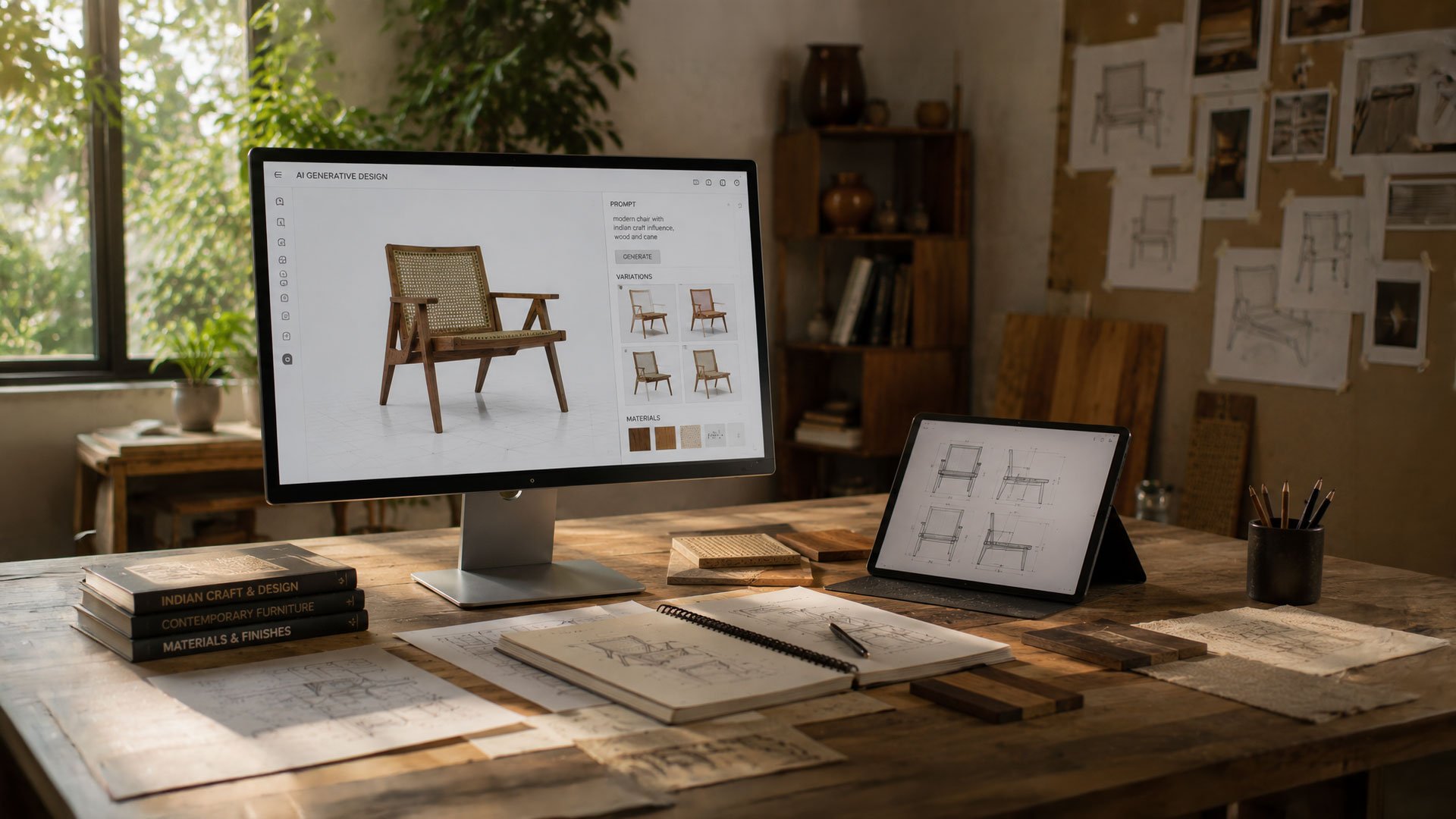
There is a conversation happening in design studios right now.
It is about AI. About what it can do, what it cannot, and what it might quietly displace if no one is paying attention.
It is worth having honestly.
Table of Contents
- How AI Is Transforming the Furniture Design Industry
- What AI-Driven Furniture Design Actually Looks Like Today
- How AI Helps Designers Create Faster
- AI vs Human Craftsmanship: Where Technology Falls Short
- How Indian Craft Traditions Contrast with AI-Led Design
- Can AI and Artisans Work Together in Modern Furniture Making
- The Role of Personalisation in AI-Powered Furniture Design
- Risks of Over-Automation in Creative Industries
- What This Means for the Future of Indian Craftsmanship
- How Casa Carigar Balances Innovation with Authentic Craft
How AI Is Transforming the Furniture Design Industry
Artificial intelligence furniture design tools have moved well past novelty.
Generative design software can now produce hundreds of structural variations for a single brief in the time it once took a designer to sketch a first draft.
Platforms use machine learning to analyse spatial data, material performance, and consumer preference simultaneously.
What used to require weeks of iteration can be compressed into hours.
This is genuinely useful. It is also, depending on where you sit, genuinely unsettling.
The Casa Carigar manifesto holds a clear position on where technology belongs in this conversation.
The platform uses AI, design tools, and an editorial backend so that traditional workshops can reach modern homes, precisely so the authentic work of artisans does not have to change to be found. Technology serves tradition. Not the other way around.
What AI-Driven Furniture Design Actually Looks Like Today
In practice, how is AI being used in furniture design right now?
Large manufacturers are using generative design furniture tools to optimise structures for material efficiency. Input the load requirements, the material properties, the manufacturing constraints, and the algorithm returns forms that a human designer might never have thought to draw. Some of these forms are extraordinary. Others look exactly like what they are: outputs from a process that has never touched a piece of wood.
Digital design in home decor has also entered the consumer side. AR visualisation tools let buyers see a piece in their actual room before it is produced.
Smart furniture design tools now allow real-time customisation of dimensions, finishes, and materials. The distance between brief and object is shrinking.
How AI Helps Designers Create Faster
Speed is the most straightforward case for AI in interior design.
A designer working on a hospitality project can use AI to generate and test twenty spatial configurations before committing to one.
Custom furniture design using AI cuts the back-and-forth of early concepting. Pattern generation, colour palette analysis, structural simulation: these are tasks that technology handles quickly and well, freeing the designer for the decisions that actually require judgement.
Arjunvir Gujral Design Studio applies this discipline directly. Before any workshop execution begins, they map out every product through detailed digital illustrations and CAD drawings, eliminating uncertainty in bespoke architectural furniture manufacturing before a single piece of wood is cut. Pre-production visualisation as standard practice, not as an afterthought.
Home of Chirmi uses digital tools at an earlier stage. Their advanced computer-aided cutting algorithms optimise raw lumber yards, minimising wood waste during the production of premium hardwoods like Ash and Wenge. Eco-conscious manufacturing that begins with software before it reaches the workshop floor.
That is the honest version of this conversation. AI does certain things faster and more precisely. For studios managing complex or material-sensitive work, that matters.
AI vs Human Craftsmanship: Where Technology Falls Short
Here is where it gets interesting.
A generative design tool can produce a structurally optimised chair. It cannot produce a chair with grain that runs in exactly the right direction through a curved leg because a craftsman knew how the wood would behave under stress three months later. It cannot account for the way a particular piece of teak, cut from a specific tree in a specific season, will develop its patina over twenty years.
AI vs handcrafted furniture is sometimes framed as efficiency against tradition. That framing misses the point. The real distinction is between objects optimised for performance and objects made with accumulated knowledge. Those are different things. They look different. They age differently. They mean different things in a room.
Anantaya makes this legible. Their creation process begins directly in the hands of master artisans and through historical research, rather than a digital software template. The knowledge that shapes each piece predates any algorithm that could be written to replicate it.
How Indian Craft Traditions Contrast with AI-Led Design
India has a design intelligence that does not live in software.
The mortise-and-tenon joinery of Saharanpur, refined across generations of woodworkers, is structurally sound precisely because it was tested not in simulation but in actual use across actual climates.
The hand-beaten texture of copper vessels from Moradabad is not a stylistic choice. It is the record of a process. The variation in a hand-knotted dhurrie from Jaipur is not inconsistent. It is the signature of the hands that made it.
Technology in Indian craftsmanship is worth discussing. But the premise that AI can replicate what four hundred years of material practice produces is one worth questioning carefully.
Can AI and Artisans Work Together in Modern Furniture Making
The more useful question is not whether AI threatens craft, but whether it can serve it.
The answer is yes, in specific and limited ways.
AI-generated visualisations can help an artisan communicate a commission to a client who struggles to read a technical drawing. Digital tools can handle the specification and logistics infrastructure that has historically kept small workshops invisible to the wider market. AR tools can show a piece in a client's room before it leaves the workshop, which is genuinely valuable for both sides.
The technology amplifies the hand. It does not replace it. That distinction is the only one that matters.
The Role of Personalisation in AI-Powered Furniture Design
This is where AI does something genuinely interesting for the buyer.
Custom furniture design using AI now means a client can specify material, finish, proportion, and regional provenance within a single digital interface and see the result rendered in their actual space. That is not a threat to craft. That is the infrastructure for it.
The personalisation AI enables can, when used well, direct more commissions toward individual makers rather than fewer. It lowers the friction between the person who wants a specific piece and the craftsman who can make it.
Risks of Over-Automation in Creative Industries
The risk is not AI itself. It is the assumption that faster is always better.
When studios begin outsourcing early concepting entirely to generative tools, they lose the instinctive development that comes from working through a brief by hand. When manufacturers optimise entirely for material efficiency, they lose the tolerance for the beautiful inefficiencies that make handcrafted objects worth having. When platforms prioritise volume over curation, the objects that require the most skill and time become the hardest to sell.
The impact of AI on artisans is not inevitable. It is a set of choices made by platforms, designers, and buyers. Choices about what they value enough to protect.
What This Means for the Future of Indian Craftsmanship
Three master woodcarvers retired in Saharanpur last year. Their techniques went with them, partly because there was no infrastructure to document them, find buyers for them, or make the economics of passing them on viable.
That is not an AI problem. It is a systems problem. And it predates AI by decades.
The future of Indian craftsmanship depends less on how designers respond to generative tools and more on whether the makers who hold irreplaceable knowledge have the infrastructure to keep working. Specification-grade catalogues. Intelligent search. Accountable logistics. The ability to reach an architect in Mumbai or a homeowner in Singapore without three intermediaries.
That is what the craft needs. Technology can build it. Or it can ignore it entirely in favour of churning out optimised objects with no origin story.
How Casa Carigar Balances Innovation with Authentic Craft
Casa Carigar uses technology exactly where it belongs.
CasaAI handles AR visualisation so a buyer can see a hand-carved console from a Jodhpur workshop in their actual room before it is commissioned. Intelligent search connects a designer sourcing by material, technique, and region to the right maker directly. The logistics infrastructure means that a piece that took six months to make does not take six months to arrive.
None of this replaces the craftsman. All of it makes the craftsman more reachable.
The quiet marks, the subtle material variations, the unsung authorship that give a piece its character over decades: these are what The Artisan's Signature You Didn't Notice is about. No generative tool produces them. No CAD drawing anticipates them. They are the reason the craft matters, and the reason the infrastructure exists to protect it.
Explore the collection at Casa Carigar.
FAQs
How Is AI Used in Furniture Design?
AI supports furniture design by generating design variations, analysing customer preferences, and enabling real-time customisation. It also helps buyers visualise furniture in their homes through AR tools before making a purchase.
Can AI Replace Furniture Designers?
No. While AI can streamline ideation and improve efficiency, it cannot replicate human creativity, material expertise, or the cultural understanding that informs truly thoughtful design. It works best as a tool that supports, rather than replaces, skilled designers.
What Are the Benefits of AI in Interior Design?
AI helps with:
- Speeding up planning and spatial configuration
- Improving visualisation through AR tools
- Simplifying customisation for buyers and designers
For both designers and homeowners, it makes decision-making more efficient while creating a smoother path from concept to finished space.
Is AI a Threat to Traditional Craftsmanship?
AI is not inherently a threat to craftsmanship. When used thoughtfully, it can help artisans reach wider audiences and improve workflows. The challenge arises when technology prioritises scale and cost over the value, skill, and heritage behind handcrafted work.
Casa Carigar
From the Casa Carigar workshop