Why Hand Knotted Rugs Last Longer Than Machine Made
Hand Knotted Rugs India: Why They Last Longer Than Machine Made
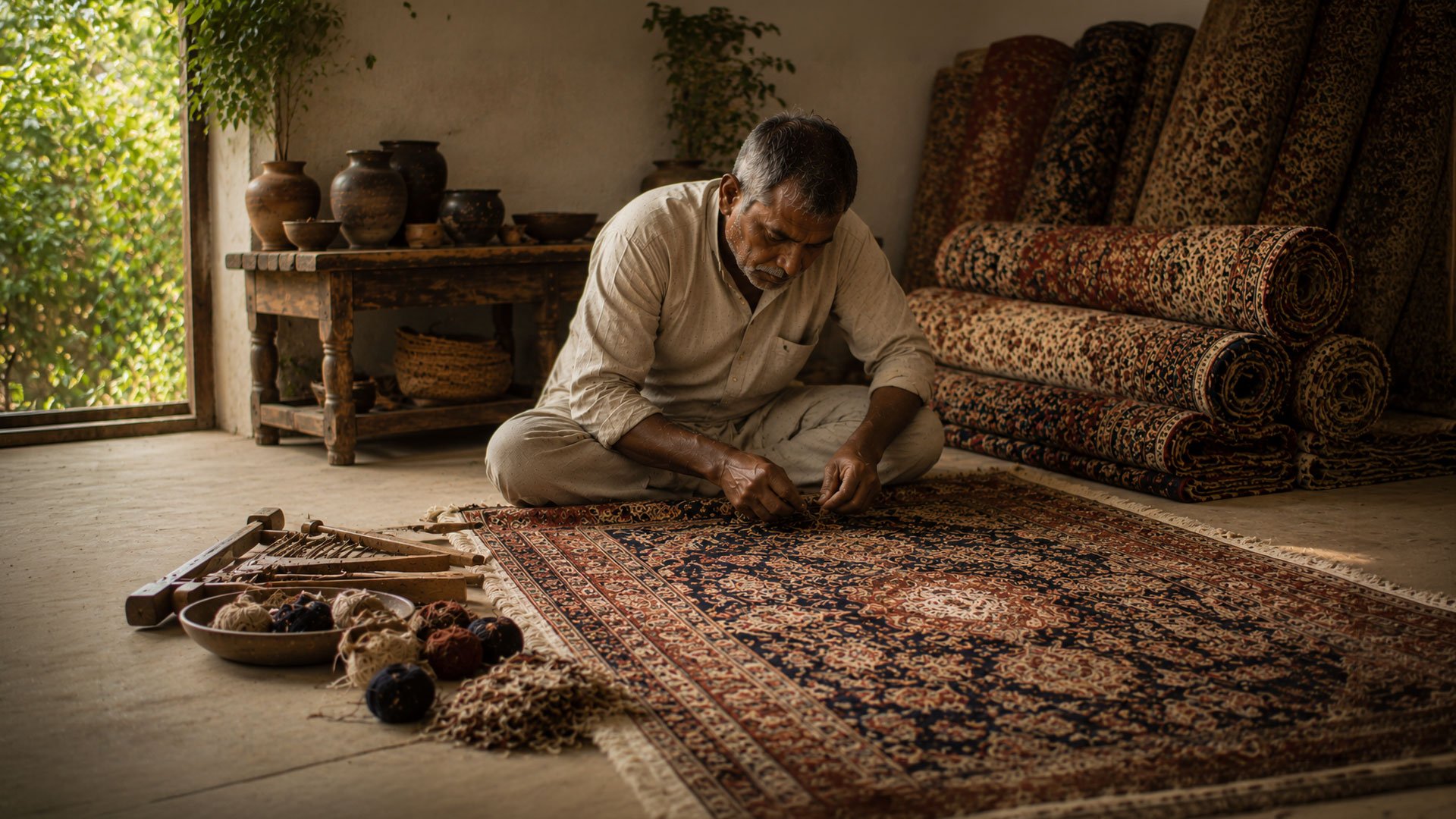
Table of Contents
- Hand-knot rugs India vs machine-made
- Why hand-knot rugs are built to last for decades
- How hand-knotting makes rugs stronger
- Materials used in Indian hand-knotted rugs and their impact
- How craftsmanship affects rug longevity
- Are hand-knotted rugs worth the investment for Indian homes
- How Casa Carigar curates long-lasting handcrafted rugs
Hand-Knot Rugs India vs Machine-Made
The difference between a hand-knotted rug and a machine-made one is not a matter of aesthetics. It is a matter of construction.
A machine-made rug is woven fast, on a power loom, with synthetic or low-grade fibre looped or tufted through a backing material.
The pile is held in place by latex or adhesive. It looks fine on day one. By year three, the backing starts to separate, the pile flattens, and the edges begin to fray.
Most machine-made rugs have a realistic lifespan of five to ten years with regular use.
A hand-knotted rug from a workshop in Jaipur or Bhadohi is built differently at every level. The pile is not looped or glued.
Each knot, whether a Persian Senneh or a Turkish Ghiordes, is tied by hand around the warp threads, cut, and combed.
The rug holds together because of its structure, not its adhesive. There is no backing to delaminate. There is nothing to give out.
Why Hand-Knot Rugs Are Built to Last for Decades
The durability of hand-knotted rugs is not a marketing claim. It is the result of how they are made and what they are made from.
A single square foot of a hand-knotted rug can contain anywhere from a hundred to over a thousand individual knots, depending on the knotting density.
A finer Agra carpet might have three hundred knots per square inch. Each of those knots is a structural unit. The more knots, the denser the weave, and the longer the rug lasts under foot traffic.
Machine-made rugs cannot replicate this density in a meaningful way. The pile is held to a surface rather than woven through a structure. The moment the adhesive weakens, the pile has nothing to hold it.
A well-made hand-knotted rug, maintained properly, lasts between fifty and a hundred and fifty years. Some of the pieces documented in Indian palace collections are over two centuries old and still intact.
How Hand-Knotting Makes Rugs Stronger
The knot is not just a technique. It is an engineering decision.
When a weaver ties a knot around the warp threads, they are locking the pile into the foundation of the rug itself.
The warp and weft create a grid of tension. Every knot reinforces that grid. Foot traffic is distributed across the entire structure rather than concentrating on a surface layer.
This is why Indian handmade carpets of quality do not develop bald patches the way machine-made rugs do.
Wear, when it happens at all, is gradual and even. The rug's character changes over decades rather than deteriorating.
The fringe on a hand-knotted rug is also structural, not decorative. It is the continuation of the warp threads.
Cutting it or letting it fray is actually damaging the rug's foundation. On a machine-made rug, the fringe is sewn on separately.
Materials Used in Indian Hand-Knotted Rugs and Their Impact
Wool is the material that made India's rug tradition what it is. Hand-spun, hand-carded wool from the high-altitude pashmina sheep of Rajasthan or the Bhadohi district carries a lanolin content that makes it naturally resistant to dirt, moisture, and compression.
It recovers after being walked on. Unlike synthetic pile, which compresses permanently and loses its structure over time, wool fibre springs back, maintaining the rug's height and density even under sustained foot traffic.
Silk knotted rugs, produced in workshops in Varanasi and parts of Kashmir, are among the most durable natural fibre rugs in the world.
Silk does not absorb moisture, does not rot, and maintains its sheen for generations.
A silk-on-silk carpet from Varanasi, knotted at a high density, will outlast most furniture in the room it inhabits.
Natural fibre rugs made from cotton warp and wool pile represent the middle ground: accessible, hardwearing, and capable of lasting two to three generations with reasonable care.
Synthetic pile rugs, regardless of how they are constructed, compress permanently and do not recover.
How Craftsmanship Affects Rug Longevity
Wear and Tear: How Handmade Rugs Age Over Time
Ageing is where hand-knotted rugs diverge most clearly from machine-made ones.
Machine-made rugs decline. Hand-knot rugs develop. The colours in a naturally dyed wool rug settle and deepen over the years.
Vegetable dyes, used in heritage workshops across Rajasthan and Kashmir, become more interesting with exposure to light rather than fading to grey.
The pile develops a patina that cannot be replicated in a new piece.
A thirty-year-old hand-knotted rug from a reputable workshop is often worth more than a new one of similar construction.
The opposite is true of machine-made rugs, which are worth nothing after a decade.
Maintenance and Care: Extending the Life of Your Rug
Hand-knotted rugs do not require complicated care. They require consistent, considered care.
- Rotate the rug every six to twelve months if it sits in a high-traffic area, so that wear distributes evenly.
- Vacuum without a beater bar, along the direction of the pile.
- Have the rug professionally cleaned by a specialist who hand-washes and dries flat every three to five years. This removes ground-in particulate that, over time, acts like sandpaper on the pile base.
- Keep the rug away from direct sunlight for long periods, particularly if the dyes are vegetable-based.
- Place a rug pad underneath, cut slightly smaller than the rug itself, to prevent slipping and reduce friction on the foundation threads.
- Moths are the one genuine threat to a wool rug. A rug in use is rarely affected because regular foot traffic and air circulation prevent infestation. A rug stored rolled in a dark space is vulnerable. Cedar blocks and occasional airing are sufficient precautions.
Are Hand-Knotted Rugs Worth the Investment for Indian Homes
The question worth asking is not whether the rug is expensive. It is whether it will still be in the room in thirty years.
A hand-knotted rug from a skilled workshop in Bhadohi or Jaipur costs more than a machine-made alternative at the point of purchase.
Over the span of its life, it costs considerably less. A machine-made rug replaced every seven years over thirty years, costs more in aggregate, and produces more waste than a hand-knotted rug maintained through the same period.
The rugs that families in India have kept for generations were not kept because they were too expensive to replace.
They were kept because they were worth keeping. Because they held the light in a particular way, because they recorded the room's history in their pile, because replacing them would mean losing something that could not be bought back.
That is the actual case for hand-knotted rugs. Not durability as a technical specification. Durability as a reason to stay.
How Casa Carigar Curates Long-Lasting Handcrafted Rugs
Every rug in the Casa Carigar collection comes from workshops that have been audited for material quality, dyeing practice, and knotting density.
Studios like Cocoon Fine Rugs and The Ambiente represent exactly the kind of maker this platform was built around: workshops where synthetic dyes are not a shortcut taken, and where latex backing is simply not part of the process.
Where it is known, each listing carries the wool or silk provenance, the weaving town, the technique, and the maker's name. Because a rug is not a floor covering.
It is a record of the hands that made it, and it will outlast most things in the room it occupies.
Discover the collection at casacarigar.com.
FAQ
Do hand-knot rugs last longer than machine-made rugs?
Yes, significantly. A well-maintained hand-knotted rug lasts fifty to a hundred and fifty years. Machine-made rugs, which rely on adhesive backing rather than structural knotting, typically last five to ten years under regular use.
How long do hand-knotted rugs typically last?
With proper care, between fifty and a hundred and fifty years. Some documented Indian palace rugs are over two centuries old and still intact.
What makes hand-knotted rugs more durable?
The construction method. Each knot is tied by hand around the warp threads of the foundation, creating a structural hold rather than a surface attachment. The pile cannot delaminate because it is woven into the rug's foundation, not glued to a backing.
Are hand-knotted rugs a good investment?
Over the full life of the piece, yes. A hand-knotted rug maintained over thirty years costs less in aggregate than replacing machine-made alternatives every seven years, and holds or value increases rather than declining to zero.
Casa Carigar
From the Casa Carigar workshop