The Collector's Guide to Vintage Indian Textiles: Kantha, Phulkari, and Kalamkari
Kantha, Phulkari, Kalamkari: India’s Most Collectible Textiles
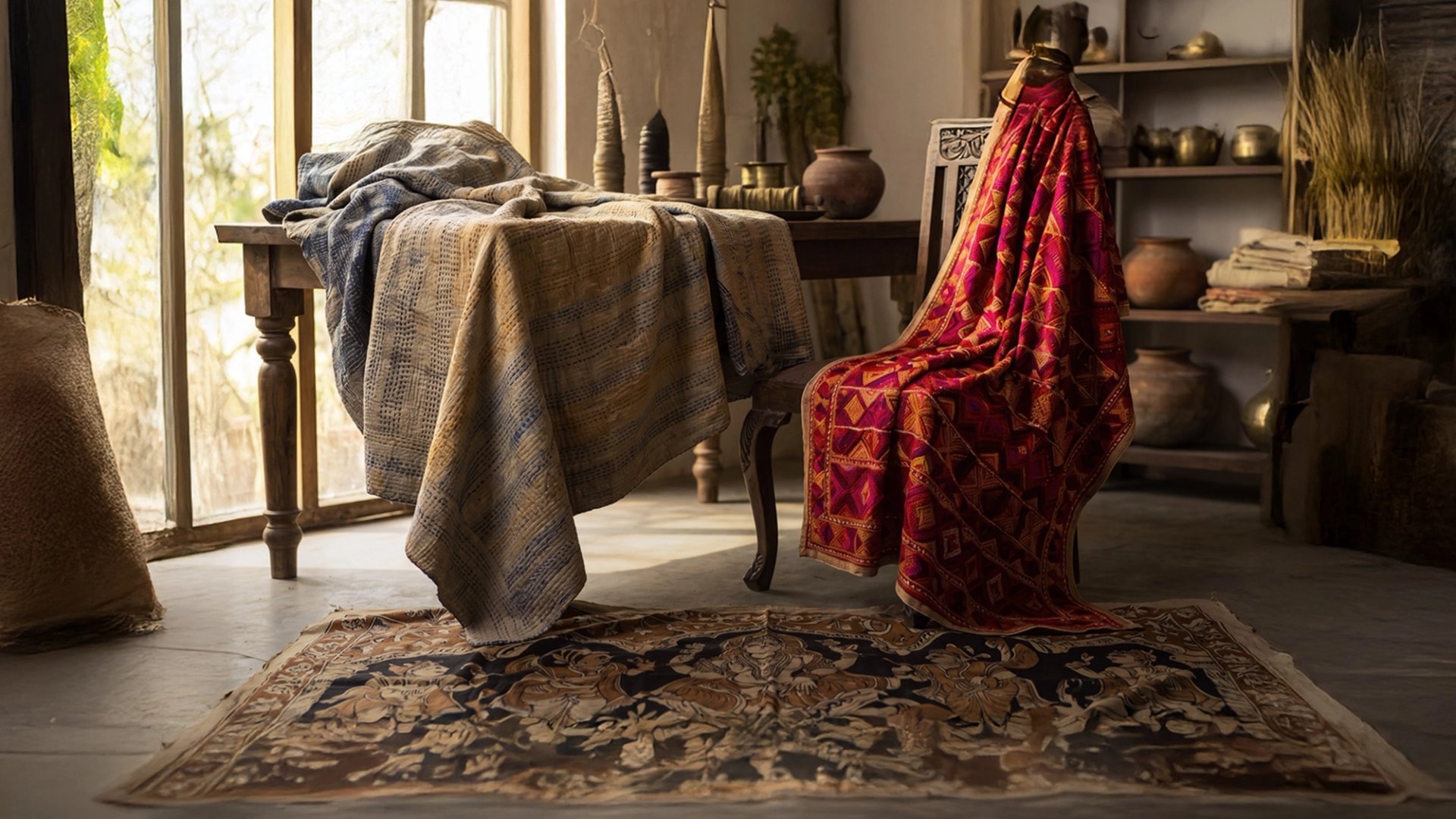
The history of vintage Indian clothing reflects a journey of human ingenuity and mobility, intrinsically tied to the traditions of use, reuse, and revival.
Collecting starts with understanding the nuanced evidence in thread, dye, and composition, while also recognising how quickly those signs can be flattened into a generic “heritage” look.
Vintage Indian textiles are traditional cloth forms whose value is shaped by technique, provenance, and cultural significance, rather than merely by decorative appeal. Collecting begins with informed observation.
This vintage Indian textile collecting guide moves through three touchstones in the marketplace and in public memory: Kantha, Phulkari, and Kalamkari.
Each builds meaning after the loom through embroidery, dyeing, painting, and printing. In each case, the technique functions as evidence, even when speed and cost begin to press on the method.
Key Takeaways:
- Process as Identity: The way a textile is made (repair, ritual, or export demand) is what defines its historical value
Kantha: The Art of Reuse
- The Concept: Known as the "afterlife of cloth," where old saris are layered and given new life
- The Technique: Defined by the running stitch, often using thread pulled from the original fabric
- Regional Variations: Ranges from the figurative motifs of Nakshi Kantha to the geometric, non-figurative Muslim traditions
Phulkari: Embroidery as Ceremony
- The Signature: Total surface saturation, where the embroidery becomes the main event, not just a base
- The Method: A counted-thread darning stitch worked from the reverse side to create a geometric radiance
- Social Forms: Includes the Bagh (high density), Chope (ceremonial marriage cloth), and Sainchi (narrative scenes)
Kalamkari: Line and Narrative
- The Tools: Direct "pen work" using a bamboo kalam and natural dyes like indigo and madder
- Srikalahasti Style: Freehand drawings of religious epics and temple narratives
- Machilipatnam Style: A blend of hand-painting and block-printing influenced by global export history
Kantha: The Afterlife of Cloth
Among vintage Indian textiles, Kantha begins with what is worn. In Bengal, old saris and dhotis are layered and stitched together to extend a textile’s life, turning rags into textile riches.
That origin changes how Kantha reads. It is a practice of repair turned into artistry, and that sequence changes how you should look at it.
Instead of treating the cloth as a pristine field awaiting decoration, you look for the conversation between layers: where the stitch holds memory in place, where it compresses wear into pattern.
How to look: stitch, layer, and the hand
The basic Kantha stitch is the running stitch, with multiple variations. When you know this, you stop expecting the surface to behave like satin embroidery or dense couching.
Running stitch has a particular honesty. It can be rhythmic and restrained, but it also exposes the hand through small shifts in spacing.
Traditionally, the thread used for Kantha could be pulled from the sari itself. That is not only a material fact. It is a clue to the aesthetic.
If thread and cloth share an origin, the work is less about contrast and more about continuity. The stitch becomes a way of keeping the textile within itself.
Collectors often first meet the category through the market’s compressed phrase “Vintage Kantha embroidery.” The cloth carries the motif of reuse.
Variety within Kantha: one name, many lineages
The temptation in the market is to treat Kantha as one look: running stitch, Bengali, “vintage.”
However, these traditions exist across Bengal, with district-level distinctions that remain under-documented.
These are some specific types: Nakshi Kantha with figurative motifs, patchwork Kantha, and Kantha with calligraphy.
Most importantly, the sources point to a Muslim Kantha tradition, with Murshidabad offered as an example, characterised by geometric design and a near absence of figurative motifs. This is not a decorative footnote.
It matters for collectors because it interrupts lazy assumptions about what Kantha “should” depict.
It also matters historically because it signals how communities shape textile language through religious and social preference, not through an abstract idea of style.
Kantha’s modern turn: craft, livelihood, and visibility
Kantha has been associated with women’s spare-time work that increasingly becomes income-generating as appreciation and awareness grow.
Visibility can support livelihoods. It can also shift what gets produced, for whom, and how quickly. Both belong to the same present.
Kantha teaches one lesson early: the afterlife of cloth is not a compromise. It is authorship.
Phulkari: When Surface Becomes a Ceremony
Phulkari is the heirloom embroidery of Punjab and Haryana. It is characterised by geometric fields worked in silk floss on coarse, hand-spun, hand-woven cotton (khadi), meant to be used, gifted, exchanged, inherited, and kept.
In the collector’s market for vintage Indian textiles, Phulkari is often translated as “flower work,” but its deeper signature is saturation.
Phulkari is about surface taking over. Here, the background cloth is given full embroidery, so that the cloth becomes an event rather than a base.
Counted thread, controlled radiance
The main stitch is a long-and-short darning stitch worked from the reverse side by counting threads, with other stitches used occasionally, including satin, stem, chain, herringbone, buttonhole, and double running.
Even if you cannot name these stitches, the method matters. Working from the reverse side by counting threads produces a particular kind of order, and it shapes why motifs in many phulkaris feel both geometric and intensely alive.
Before embroidery began, the ground cloth was often dyed at home in colours including madder red, chocolate brown, indigo blue, or black.
Phulkari also sits firmly within traditional Indian embroidery with a social life: cloth made for auspicious occasions and rites, including birth, marriage, and death rites, as well as festivals and daily use.
Phulkari’s internal taxonomy: names that signal function
Phulkari becomes truly legible once you stop treating it as one thing and start recognising its named forms:
Bagh
It is so densely embroidered that the base cloth is barely visible. Reflective floss thread can create a multi-hued effect that reads like silk.This is a density category: embroidery saturates the surface until the base cloth recedes.
Thirma
It carries a specific colour scheme and appears in a girl’s trousseau.
Sainchi
Sainchi moves into narrative: scenes from life or legend, figurative motifs that break the rigidity of counted-thread work and allow self-expression.
Sainchi signals narrative impulse and freer figurative movement.
Darshan Dwar
This form is described as figures arranged within a grid evoking architectural panels or doorways, created for a religious offering.
Darshan Dwar holds a grid logic tied to an offering. It also appears through a symbolic lens, framed as temple offerings imagined through “doors” rendered in geometry and ornament.
It is placed within a bright primary-colour tradition across districts, including Amritsar, Jalandhar, Ferozepur, Bathinda, and Tipri village in Patiala district.
Chope
This form carries a life-cycle story: begun by the maternal grandmother at a granddaughter’s birth and offered at her marriage.
The yellow thread on red cloth is auspicious, and it describes a double darning stitch producing identical motifs on both sides, with the pallav endpiece left unembroidered.
Chope carries the double-sided identity produced by its stitch method and keeps an unembroidered pallav endpiece.
Vari-da-Bagh
This form has concentric lozenges arranged in vertical rows, with yellow silk thread often used, and it is presented to the bride by the bridegroom’s family.
Together, these forms show why Phulkari textile art is not only an ornament but a store of social time in cloth.
Kalamkari: Line, Dye, and Narrative
For collectors of vintage Indian textiles, Kalamkari is where line becomes story and process becomes evidence.
If Kantha begins with the worn and Phulkari begins with the field, Kalamkari begins with the line. It is the tradition here most directly bound to storytelling and to process complexity.
It is a traditional pen work associated with painting and printing on cotton, using natural dyes, with techniques that include mordants and repeated treatments for colour fastness.
This is the history of Kalamkari fabric written into a method of time and technique.
Two centres, two temperaments, two styles
Kalamkari is mainly practised in Andhra Pradesh and identifies two distinct styles associated with two centres: Srikalahasti, linked to pen work, and Machilipatnam, linked to painting and printing, also connected to Coromandel chintz.
Srikalahasti: pen work tied to temple narrative
Srikalahasti is characterised by freehand work executed with a bamboo kalam (pen) used to draw and fill colour, with textiles such as scrolls, hangings, and banners referencing Hindu myth and legend.
It is world-famous for Kalamkari patas, stating continuity since around the 17th century, and noting the long, complex process and detailed depiction of epics like the Ramayana and Mahabharata.
Scenes are arranged in sequential boxes, with a major deity or central event marked centrally, and related episodes or symbols positioned around it.
Machilipatnam: printing, painting, and the world market
Machilipatnam is a mixture of painting and hand printing, historically applied to garments and home textiles, with elaborate flora and fauna designs.
The Tree of Life is a recurring motif influenced by Persian and Mughal styles.
Kalamkari’s growth has been linked to export demand across Persia, Europe, Southeast Asia, West Africa, and the Caribbean, and it treats design variation as evidence of versatility.
It is part of Kalamkari’s historical reach, and it is also part of why motifs and formats diversify.
The labour of colour
Some common colours in this style are: red from Indian madder, yellow from myrobalan flower, blue from indigo, and black from iron filings and jaggery.
The process is materially complex: stiffening cloth using astringents and buffalo milk, mordants such as alum, repeated washing, bleaching, and sunning for colour fastness, and wax used as a resist agent when combining colours.
Kalamkari’s colour is built through repeated contact between cloth, mordant, dye, water, and sun. That is one reason Indian textile craftsmanship feels so immediate here. The labour stays on the surface.
Pressure, decline, revival
Machilipatnam Kalamkari combines block printing with painting to increase productivity and cut costs.
That detail explains why two textiles can share lineage and still differ in labour intensity.
Kalamkari nearly disappeared by the mid-20th century, followed by a revival in the late 1950s attributed largely to Kamaladevi Chattopadhyaya.
The term “Kalamkari” can also travel with the technique. Mata-ne-pachhedi can be called “Kalamkari clothes” on the grounds of shared pen, mordant, and vegetable-dye technique, and screen-printed forms are noted today.
Thanjavur is also a centre for related “Kalamkari boards” since the 17th century, using block dyeing on brocade cotton with motifs such as yali, parrots, flowers, and deities, used for temple and court-related objects.
Together, these threads widen the frame of heritage fabric art without treating one region as the only centre of skill.
Conclusion: Collecting as a Record of Diversity
Kantha teaches reading through reuse: layered cloth held by running stitch, sometimes using thread pulled from the sari itself, moving between domestic and ritual use, and carrying internal traditions that range from figurative Nakshi to geometric Muslim Kantha.
Phulkari teaches reading through density and social function, where forms such as Bagh, Chope, and Vari-da-Bagh bind technique to kinship, ceremony, and offering.
Kalamkari teaches reading through narrative structure and process: pen work, printing, natural dyes, export histories, decline, and revival sit within the same lineage.
These traditions are material records. They reward the kind of attention that stays with construction, not just motif, and with process, not just polish.
Collecting Indian handmade textiles needs a trained eye and a clear vocabulary of antique Indian fabrics for what technique leaves behind.
In a market crowded with quick finishes, vintage Indian textiles remain legible in the best way: their making still shows, and their histories still hold.
Frequently Asked Questions
1. What are vintage Indian textiles?
Vintage Indian textiles are traditional fabrics whose value derives from their provenance, technical complexity, and cultural history rather than from simple decorative appeal. Unlike modern mass-produced heritage looks, these pieces are material records of ritual use, repair, and ancient trade routes. They represent a trail of labour, often involving hand spinning, natural dyeing, and meticulous hand embroidery.
2. How can you tell if Kantha is vintage?
Identifying authentic vintage Kantha requires looking for signs of its previous life and specific technical markers. True vintage Kantha is an afterlife textile made by layering old saris or dhotis. Look for the conversation between these layers and how the stitch holds the wear in place. Traditionally, the thread was pulled from the sari itself. If the thread and cloth share the same material origin, it is a strong sign of authenticity. You should also look for the running stitch. It should be rhythmic but show the subtle shifts in spacing that prove it was hand-worked rather than machine-made. Check for regional specifics such as the figurative motifs of Nakshi Kantha or the geometric patterns found in Muslim Kantha traditions.
3. Is Phulkari embroidery collectable?
Yes, Phulkari is highly sought after by collectors, particularly because it represents social time captured in cloth. Key factors for collectability include surface saturation. Premium pieces known as Bagh are so densely embroidered that the base cloth is almost invisible. Another factor is technical precision. Collectors look for the counted thread darning stitch worked from the reverse side. This method creates a unique geometric radiance that is difficult to replicate. Finally, ritual significance is important. Pieces with specific ceremonial histories such as the Chope, a wedding gift from a grandmother, or Sainchi, narrative scenes of village life, carry higher historical value.
4. Why is Kalamkari considered valuable?
Kalamkari is prized for its intense labour and its role as a medium for storytelling. Its value is built on the Kalam or pen. The Srikalahasti style involves freehand drawing with a bamboo pen, requiring immense skill to depict complex Hindu epics like the Ramayana. Another reason is natural chemistry. The labour of colour is an arduous process involving buffalo milk, mordants, and natural dyes like indigo and madder. The colour fastness is achieved through repeated sunning and washing. Finally, its value is tied to its global legacy as it has been a major export to Europe and Persia since the 17th century.
Casa Carigar
From the Casa Carigar workshop