The Ancient Dhokra Casting Technique Explained
Dhokra Casting Technique Explained: India’s Ancient Metal Art
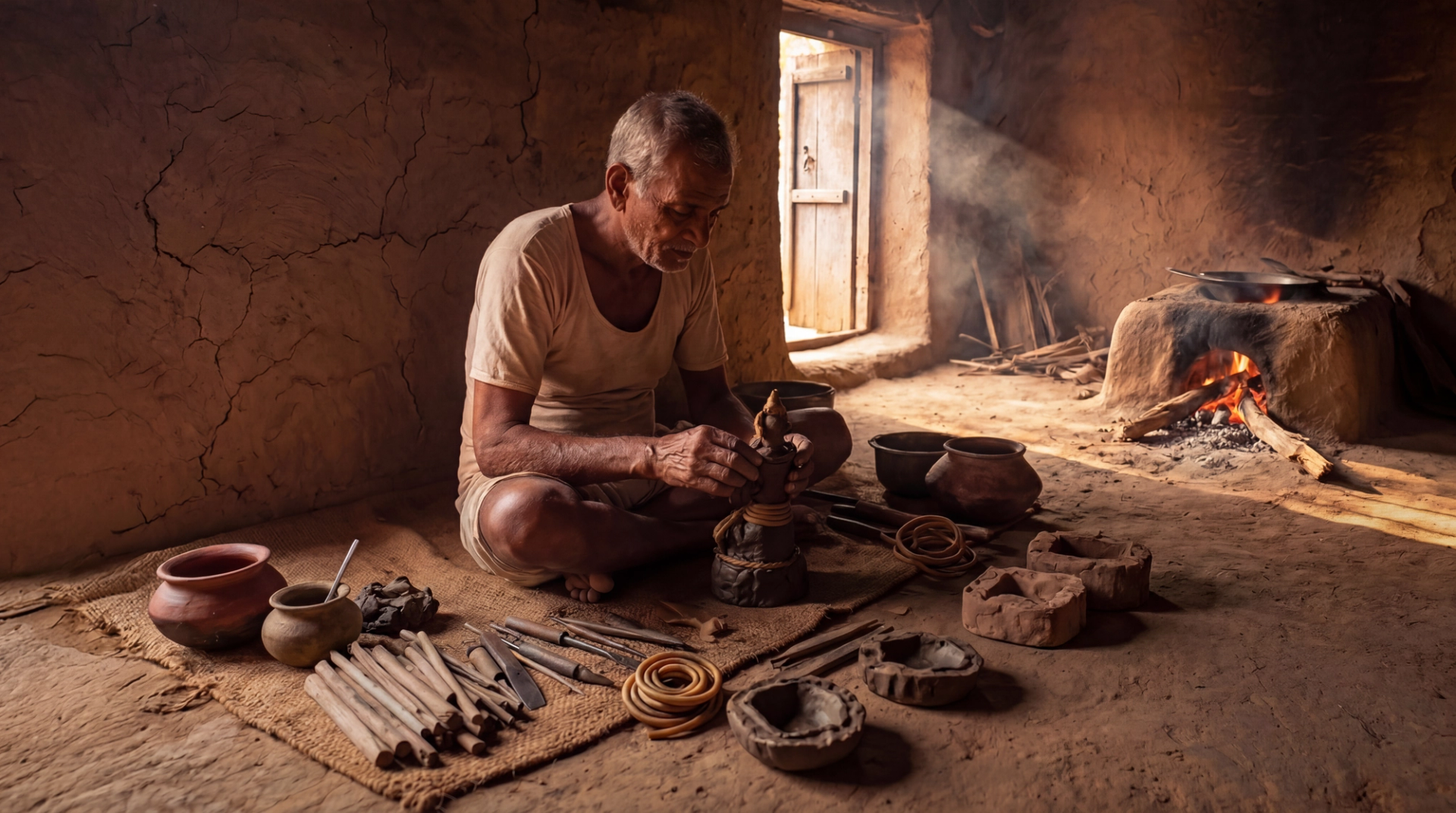
Dhokra is often introduced as an ancient craft. What survives today under the name Dhokra is not a fossilised technique carried unchanged across millennia, nor a decorative style frozen in time.
It is a working method of metal casting that has endured because it remained useful, adaptable, and embedded in everyday life.
Across central and eastern India, tribal metalworkers have continued to shape wax, clay, and molten alloy into objects that serve ritual, domestic, and symbolic roles.
What complicates the story is that Dhokra today functions as both a technical description and a category shaped by markets and institutions. The same term is used to describe regionally distinct practices, different communities, and objects made for very different purposes.
To understand the Dhokra casting technique properly, it helps to step away from romance and return to how the work is actually done, who does it, and why it has continued to matter.
Key Takeaways:
- The Dhokra casting technique is a form of lost wax metal casting in which each object is produced through a single-use clay mould, making every cast inherently unique
- The technique prioritises wax modelling over metal shaping, with form, surface, and proportion determined before casting begins
- Dhokra is not a single, uniform tradition but a category that brings together multiple regional practices, particularly across central and eastern India
- The name Dhokra is a relatively recent institutional label, adopted to group diverse tribal metal casting traditions rather than to denote a singular origin
- Knowledge of the technique is transmitted through oral instruction, observation, and repetition, not written manuals or formal training systems
- Dhokra objects are traditionally made for ritual, ceremonial, and symbolic use, where repetition and recognisability carry more value than innovation
- Motifs in Dhokra metal craft emerge from belief, function, and process, not decorative intent, with surface patterns often recording the act of making itself
- The technique’s longevity rests on its capacity to adapt to material, environmental, and economic change, rather than on remaining fixed or untouched
What the Dhokra Casting Technique Actually Is
The Dhokra casting technique is a form of lost wax metal casting in which each object is made through a single-use mould formed around a wax model. The process produces one-off metal forms, since the clay mould is broken open after casting and cannot be reused.
In practice, the technique relies on shaping the object first in wax, not metal. The wax model is built over a clay core, layered with different types of clay to form a mould, and then heated so that the wax melts out.
Molten copper-based alloy, commonly brass or bell metal, is poured into the hollow space left behind. Once cooled, the mould is broken, and the surface is cleaned and finished by hand.
This method is practised by tribal artisan communities across parts of Chhattisgarh, Odisha, Jharkhand, West Bengal, and neighbouring regions. Knowledge of the technique is transmitted orally and through apprenticeship rather than written manuals.
Outcomes cannot be fully predicted, even by experienced artisans, because the behaviour of wax, clay, fire, and metal changes with weather, materials, and scale.
Although the technique itself has deep roots in the Indian subcontinent, the term Dhokra is a more recent label that brings together several regional traditions under a single, recognisable name.
What links these practices is not a fixed visual style, but a shared dependence on the lost wax process and the cultural systems that sustain it.
How the Name ‘Dhokra’ Took Hold
The name Dhokra did not originally belong to all the metal casting traditions it now describes.
In regions such as Chhattisgarh, artisan communities historically referred to their work using local terms tied to community identity, material, or practice, rather than a single overarching label.
The wider use of Dhokra emerged much later, shaped by ethnographic writing, craft institutions, and post-independence efforts to categorise and promote regional handicrafts within national and urban frameworks.
Scholars and cultural bodies began using the term as a convenient grouping for several lost wax casting traditions practised by tribal metalworkers across eastern and central India, even though these practices differed in form, context, and local naming.
Over time, the label gained currency in exhibitions, state programmes, and markets, and artisans adopted it pragmatically as a shared language that allowed their work to circulate beyond local settings.
The term Dhokra thus functions today less as a marker of singular origin and more as a category shaped by institutional recognition and exchange, under which multiple regional practices continue to coexist.
Dhokra metal craft from Bastar, Chhattisgarh
How the Dhokra Casting Technique Works on the Ground
The Dhokra casting technique follows a fixed sequence of actions, but each stage depends on judgement, timing, and material behaviour rather than mechanical precision.
Where the process begins: wax, not metal
To understand the Dhokra casting technique, it is helpful to begin with what artisans consider the true starting point of the process. It is not metal. It is wax.
Every Dhokra object begins as a handcrafted wax form. The wax determines proportion, gesture, and surface detail long before any alloy is melted.
Artisans work the wax over a clay core, adding and shaping it gradually, often using simple tools and their fingers. Once the mould is sealed and fired, there is no way to correct or refine the form.
Building the mould: clay, layers, and heat
After the wax model is completed, it is covered in successive layers of prepared clay. Different clays are used for different purposes.
Coarser clay gives strength to the mould, while finer layers capture surface detail. Channels are added to allow molten metal to flow and air to escape.
The mould is then dried and heated. As the temperature rises, the wax melts and drains out, leaving behind a hollow cavity shaped exactly like the original wax form.
Casting the metal: one object, one mould
Molten metal, usually a copper-based alloy such as brass or bell metal, is poured into this cavity. Once the metal cools and solidifies, the clay mould is broken open.
This moment is decisive. Each mould is destroyed in the process, which is why no two Dhokra objects are ever identical.
The cast surface is then cleaned, filed, and polished by hand. Minor flaws may be corrected, but the overall form is fixed.
Working with uncertainty: skill built through repetition
Throughout this sequence, artisans work with materials that behave unpredictably.
Wax softens differently depending on temperature. Clay cracks if the moisture levels are wrong. Metal flow can fail if the heat is uneven.
The technique, therefore, relies not on precision instruments but on accumulated judgement developed through repeated practice.
Indigenous knowledge and procedural language
In Chhattisgarh, the Dhokra casting technique is organised through a precise indigenous vocabulary. Each stage of work has a name, and these terms function as both technical markers and teaching tools within the community.
Indigenous Procedural Stages in the Dhokra Casting Technique
Stage of Work
Indigenous Term(s)
Function in the Process
Wax cleaning and preparation
Main Jhorna / Dhoowan Churouta
Cleaning and boiling raw wax
Wax thread making
Main Tigal
Creating wax filaments for form-building
Clay preparation
Mati Banaasot / Mati Gharuta
Preparing different clay mixtures
Core formation
Mulaa / Khunt
Building the internal clay core
Wax modelling
Matna / Dhoopan Kaaj
Shaping the final wax form
Channel creation
Kheela / Nikas
Forming passages for metal flow
Mould layering
Baran Mati / Uperi Mati
Applying clay layers over the wax model
De-waxing and firing
Main Jharaatos
Heating the mould to remove wax
Metal casting
Peetar Udoltos
Pouring molten metal into the cavity
Cleaning and finishing
Khar-Jhaar Kartos
Breaking the mould and refining the surface
Indigenous Procedural Stages in the Dhokra Casting Technique
Why the Dhokra technique remains vital today
This vocabulary reflects how the technique is learned and remembered. Instructions are not abstract.
They are embedded in action, sequence, and speech. Knowledge is passed on by watching, repeating, and correcting, rather than by following written instructions.
Seen this way, the Dhokra casting technique is less a formula than a practised rhythm. Each object demands the same stages, yet every casting responds to a slightly different set of conditions.
That balance between repetition and uncertainty is what has kept the technique alive, even as materials, markets, and contexts have changed.
The Communities That Have Carried Dhokra Forward
The continuity of the Dhokra casting technique rests on the labour of specific communities who have treated metal casting as both livelihood and inherited responsibility.
Understanding who these communities are and how they have worked is essential to understanding how the technique has survived.
Metal casting as a livelihood in Chhattisgarh
Moulding Clay for Dhokra Art
In Chhattisgarh, the Dhokra casting technique has been practised primarily by artisan communities such as the Ghadwa, also known as Ghasiya, and the Jharekha.
Historically, these groups were not specialised metalworkers in the narrow sense. Casting formed part of a broader livelihood that included agriculture, forest gathering, cattle rearing, and seasonal movement.
Metalwork was integrated into this way of life rather than separated from it. Objects were made to meet local needs, including ritual figures, household implements, and symbolic forms used within village and forest-based communities.
Knowledge of casting was passed down within families, learned through observation and participation rather than formal instruction.
Over time, economic pressures and changing land use patterns altered this balance. In several districts, metal casting became a more central source of income, particularly as state programmes and urban markets created demand for Dhokra objects beyond local use.
Bastar and the regional shape of the Dhokra metal craft
Within Chhattisgarh, Bastar occupies a distinct place in discussions of Dhokra metal craft. The region is often identified as a major centre of lost wax casting, not because it represents a single style, but because it sustains a dense concentration of skilled artisans and long-standing ritual practices.
In Bastar, metal casting has been closely tied to the making of ritual figures, including representations of local deities known as devatas.
These objects are not conceived as decorative items. They are produced for specific ceremonial contexts and are understood to carry religious and social significance. The form, scale, and finish of such figures reflect this purpose.
The Ritual and Domestic Purpose of Dhokra Metalwork
The forms produced through the Dhokra casting technique are often approached today as decorative artefacts. That framing reflects how they circulate in galleries and markets.
It does not explain why these objects were made in the first place, or how they continue to function within the communities that produce them.
For many artisan groups, metal casting has long been tied to ritual use.
Objects are created not as expressions of individual authorship, but to serve specific social, ceremonial, and religious needs. Meaning is located in use, placement, and repetition rather than novelty.
Ritual use, deity-making, and purpose
In regions such as Bastar, a significant portion of Dhokra metal craft has traditionally been dedicated to the making of ritual figures.
These include representations of local deities, protective spirits, and symbolic animals associated with village worship.
Such objects are commissioned for particular occasions and installed in specific settings, often connected to seasonal cycles or community rites.
The casting of these figures is understood as a serious responsibility. Artisans are aware that the object they produce will be treated as more than metal.
Proportion, posture, and surface detail are handled with restraint, not because of aesthetic minimalism, but because the form is expected to fulfil a defined role within ritual life.
Durga Idol Dhokra Art
Repetition in Dhokra forms
From an external perspective, Dhokra objects often appear repetitive. Similar figures recur across generations, with limited variation in pose or structure.
Within the cultural context of their making, this repetition is intentional.
Ritual art in many Indian traditions operates through continuity rather than innovation. Repeating established forms affirms their efficacy.
Change is introduced slowly, and often only where it does not disrupt recognition or function. In this sense, repetition is a form of discipline rather than constraint.
How Meaning Takes Shape in Dhokra Motifs
Dhokra motifs do not emerge from a desire to decorate metal surfaces. They take shape through use, belief, and repetition, forming a visual language that reflects how objects are meant to function within social and ritual life.
Human figures as social memory
Human figures appear frequently in Dhokra metal craft, but they are rarely portraits. Faces are simplified, features are understated, and individuality is deliberately muted. What matters instead is posture, stance, and action.
Figures are often shown standing upright, arms slightly extended, or engaged in everyday activities such as music-making, dancing, or carrying objects. These forms act as representations of roles rather than people.
A drummer stands for ritual performance, a dancer for celebration, a standing figure for presence or guardianship. The absence of personal detail allows the figure to remain legible across time and context.
The figure must be understood quickly and collectively. Excessive detail would distract from that purpose.
Animals as mediators between worlds
Animal forms are among the most recognisable elements of Dhokra metal craft. Horses, elephants, birds, and cattle appear repeatedly, yet their presence is not ornamental.
In many cases, animals function as intermediaries. They serve as mounts for deities, protectors of thresholds, or symbols associated with specific ritual contexts.
Their bodies are often elongated or stylised, with emphasis placed on stance and balance rather than anatomical realism.
Scale is used deliberately. An animal may appear larger or more imposing than surrounding figures to signal status or function.
Dhokra Animal Figureine
Surface pattern, geometry, and the trace of making
Beyond figures, Dhokra motifs are often embedded in surface treatment rather than applied imagery.
Linear ridges, dots, coils, and bands appear across bodies and limbs. These patterns are not separate from the process. They are frequently the result of wax threads applied during modelling.
In this sense, the surface records how the object was made. The pattern marks the hand's movement and the sequence of construction.
It does not seek to conceal the process, nor does it aim for polished uniformity. Texture becomes part of meaning.
Geometric repetition also serves a practical purpose. It strengthens form, creates visual rhythm, and allows artisans to work within familiar constraints.
The result is a surface that feels deliberate without appearing ornamental in a decorative sense.
Is Dhokra Sustainable Metal Art?
The Dhokra casting technique is often described as sustainable, largely because it is manual, small-scale, and rooted in local material use.
Historically, objects were made individually, using simple tools and nearby resources, with little emphasis on volume.
At the same time, the process involves inherent material loss. Wax is consumed, clay moulds are broken after each cast, and traditional furnaces are fuel-intensive and difficult to regulate.
Sustainability in Dhokra, therefore, is not an automatic quality of the technique but a condition shaped by scale, fuel choice, material sourcing, and working environment.
It is best understood as contextual rather than absolute, dependent on how and where the craft is practised today.
Conclusion
Seen in full, the Dhokra casting technique resists easy classification. It is neither a relic preserved unchanged nor a craft reinvented for contemporary taste.
What endures is a way of working that binds material knowledge, ritual purpose, and community practice into a repeatable yet uncertain process.
Its history is carried less by dates and documentation than by hands trained to judge wax, clay, heat, and timing.
Its motifs emerge from belief and use rather than design intent. Its name reflects institutional framing as much as lineage.
To understand Dhokra, then, is not to search for a single origin or fixed meaning, but to recognise how technical skill, cultural obligation, and adaptation have remained intertwined.
The technique survives not because it has stood still, but because it has continued to function within the worlds that depend on it.
Frequently Asked Questions
1. What is the Dhokra casting technique?
The Dhokra casting technique is a traditional form of lost wax metal casting in which each object is created using a single-use clay mould formed around a wax model. The wax determines the final form, is melted out during firing, and is replaced with molten metal, usually a copper-based alloy. Because the mould is broken after casting, every object produced through this technique is unique.
2. Why is Dhokra art called lost wax casting?
Dhokra art is described as lost wax casting because the wax model used to shape the object is destroyed during the process. When the clay mould is heated, the wax melts and drains away, leaving a hollow cavity that is later filled with molten metal. The wax is “lost” permanently, which is why the technique produces one-off forms rather than repeatable casts.
3. Which tribes practice Dhokra metal casting?
Dhokra metal casting is practised by several tribal artisan communities across central and eastern India, particularly in regions such as Chhattisgarh, Odisha, Jharkhand, and West Bengal. In Chhattisgarh, communities such as the Ghadwa (also known as Ghasiya) and Jharekha have traditionally carried the technique forward, passing knowledge through family-based apprenticeship rather than formal training systems.
4. Is Dhokra art still handmade today?
Yes, Dhokra art is still handmade today. The core stages of the Dhokra casting technique, including wax modelling, clay mould preparation, firing, and hand-finishing, are still carried out manually. While some materials and tools may have adapted to contemporary conditions, the fundamental process remains rooted in skilled handwork and experiential knowledge.
Works Cited
Image source: Wikimedia Commons
Team Casa Carigar
From the Casa Carigar workshop