How to Identify Solid Wood Furniture: What to Check Before You Buy
How to Identify Solid Wood Furniture Before You Buy
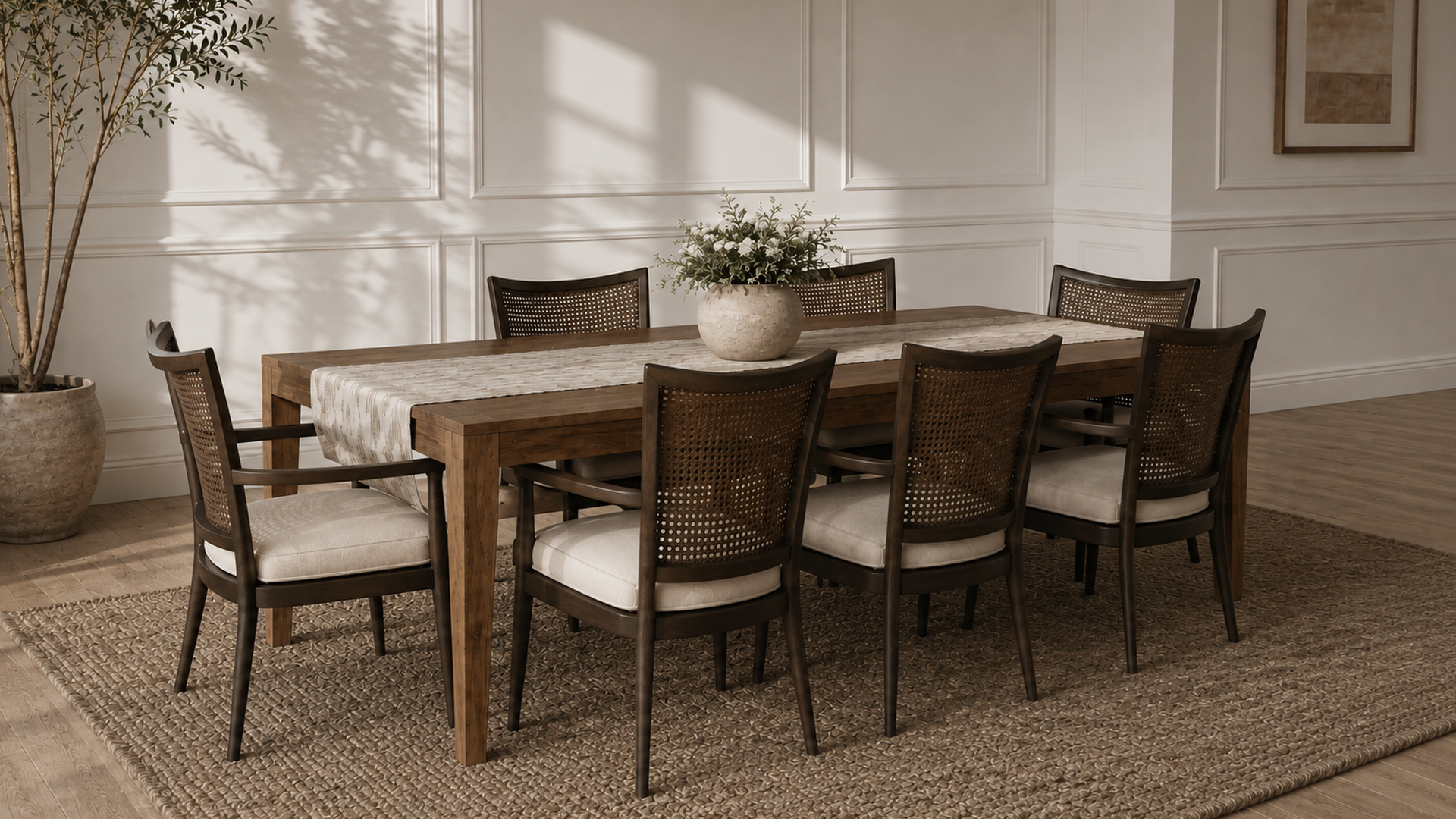
You are not just buying a table. You are buying twenty years of Sunday mornings around it.
So it is worth knowing what you are actually paying for. Most furniture in most showrooms is not what it looks like. A glossy top can hide fibreboard.
A "walnut finish" can mean nothing was ever walnut. Learning how to identify solid wood furniture is not a technical skill. It is a trust skill.
Once you know what to check, you stop guessing and start choosing.
Here is exactly what to look for.
Table of Contents
- What Does Solid Wood Furniture Actually Mean?
- Check the Wood Grain, Texture and Surface
- Look at the Edges, Ends and Underside
- Solid Wood vs Veneer: How to Tell the Difference
- Check the Joints and Construction Quality
- Pay Attention to Weight, Sound and Movement
- Ask About the Type and Source of Wood
- Spot the Difference Between Solid Wood and Engineered Boards
- Common Mistakes to Avoid When Buying Wooden Furniture
- How Casa Carigar Selects Handcrafted Wooden Furniture
What Does Solid Wood Furniture Actually Mean?
Solid wood means exactly what it says. The piece is built from planks of a single timber, joined and shaped by hand, with no composite core hiding underneath. No veneer sheet.
No printed laminate pretending to be grain. What you see on the surface is what runs through the whole piece.
This matters because solid wood ages. It develops a patina. It absorbs the life around it. Engineered wood does not do this
It stays exactly as flat and lifeless as the day it left the factory.
Check the Wood Grain, Texture and Surface
Real wood does not repeat itself.
Veneers and laminates are printed or sliced in uniform sheets, so the same knot, the same swirl, shows up again and again across a surface.
Solid wood never does this. Every plank carries its own irregularities, shifting rings, deep veins, small natural checking.
Trace a grain line on the top of a table. On solid wood, it should continue around the edge and meet the underside in a way that makes sense.
On veneer, it simply stops.
Studios that respect this difference do not sand it away. Taro Collective builds its solid Oak pieces on a policy of zero machine masking, letting the natural texture of the raw log stay exactly where it fell.
Their Kadam Collection is a good place to see this in person.
Look at the Edges, Ends and Underside
The best test is the one most people never do. Turn the piece over.
Manufacturers who use veneer rarely bother finishing what you cannot see. Pull a drawer all the way out. Look beneath a tabletop.
If the underside is raw composite board, or the grain there does not match the top, you already have your answer.
That said, not every use of engineered material is dishonest. La Dimora Selections states plainly where engineered wood is used as a deliberate design choice, such as the sharp geometric facets of their Apostrophe Coffee Table, where a solid slab would have warped under that shape.
Transparency, not concealment, is the actual standard to look for.
Solid Wood vs Veneer: How to Tell the Difference
A quick checklist before you decide:
- Grain should be irregular and never exactly repeat across the surface
- Grain lines should continue around edges and corners
- The underside and interior should match the visible surface
- Weight should feel substantial, not hollow
- Small dents or scratches should reveal wood beneath, not particleboard
Check the Joints and Construction Quality
Flat-pack furniture is held together with screws, dowels and plastic brackets, usually hidden under a colour-matched cap.
Solid wood furniture does not need any of that. It relies on joinery, mortise and tenon, sliding dovetails, interlocking box joints, wood meeting wood without shortcuts.
This is not decorative. These joints let timber expand and contract with humidity without splitting.
AKFD Studio treats this as the whole point rather than something to hide.
Their exposed joinery is visible on pieces like the Clutch Coffee Table and the Within Bed, working with the natural strengths of Acacia, Mango and Shisham.
Their Asan Range is a clean example of construction left in plain view.
Pay Attention to Weight, Sound and Movement
Lift one side of the piece. Dense hardwoods like Teak, Ash and Wenge carry real weight.
If something that looks substantial lifts as easily as a cardboard box, it is almost certainly hollow inside.
Home of Chirmi, a Jaipur studio, builds exclusively from solid, high density logs for this reason, rejecting engineered substrates from its core collections entirely.
Their Bastian Sofa is built around a solid Ash and Wenge frame, and it feels like it in the room.
Ask About the Type and Source of Wood
A good seller will tell you the species without hesitation. Teak, Sheesham, Mango, Ash, Rosewood, each behaves differently and ages differently.
If the answer you get is vague, "hardwood" with nothing more specific, that vagueness is the answer.
Ask where the timber came from too. A workshop that can trace its wood to a region and a supplier usually has nothing to hide.
Spot the Difference Between Solid Wood and Engineered Boards
Run your hand across the surface with your eyes closed. Cheap veneer is often buried under thick, glassy polyurethane that feels cold and plastic.
Genuine solid wood is usually finished with breathable, low-VOC oils or traditional stains that leave the pores and texture open to touch.
b.form studio finishes pieces like the Valeria II Dining Chair with an open-grain matte stain, keeping the Teak and White Ash beneath fully responsive to touch instead of sealed away under gloss.
Common Mistakes to Avoid When Buying Wooden Furniture
- Trusting the word "hardwood" without asking which one
- Judging quality by shine instead of touch and weight
- Skipping the underside and interior inspection entirely
- Assuming a higher price always means solid construction
- Not asking who made it or where the timber came from
Furniture that hides its construction usually has a reason to. The pieces worth living with are the ones that show their joints, name their timber, and let the grain speak for itself.
How Casa Carigar Selects Handcrafted Wooden Furniture
None of this should be a mystery you solve alone in a showroom. Every studio on Casa Carigar is chosen for exactly the honesty described above: material named, joinery visible, nothing dressed up to look like something it is not.
It is the same standard set out in the Casa Carigar Manifesto: solid teak from Mysuru, brass from Moradabad, cane from Coimbatore, each piece built by the material itself.
Conclusion
A table either has the substance to last twenty years of Sunday mornings, or it does not. Now you know how to tell the difference before you bring it home.
Discover the collection and see what genuine construction actually looks like.
FAQs
How can you tell if furniture is solid wood?
Check the grain for natural irregularity, look beneath the piece to see if the underside matches the surface, and lift it to feel real weight rather than a hollow core.
How can you tell the difference between solid wood and veneer?
Veneer patterns repeat because they are sliced from thin sheets, while solid wood grain never quite matches itself twice and continues naturally around edges and corners.
Is solid wood furniture better than engineered wood?
Not always automatically, but solid wood ages and develops character over decades, while engineered wood stays static.
The better choice depends on honesty in construction, not just the material itself.
What is the best wood for furniture in India?
Teak, Sheesham and Mango are among the most trusted for Indian conditions, each offering different durability, grain character and price points depending on the piece and its use.
Casa Carigar
From the Casa Carigar workshop